
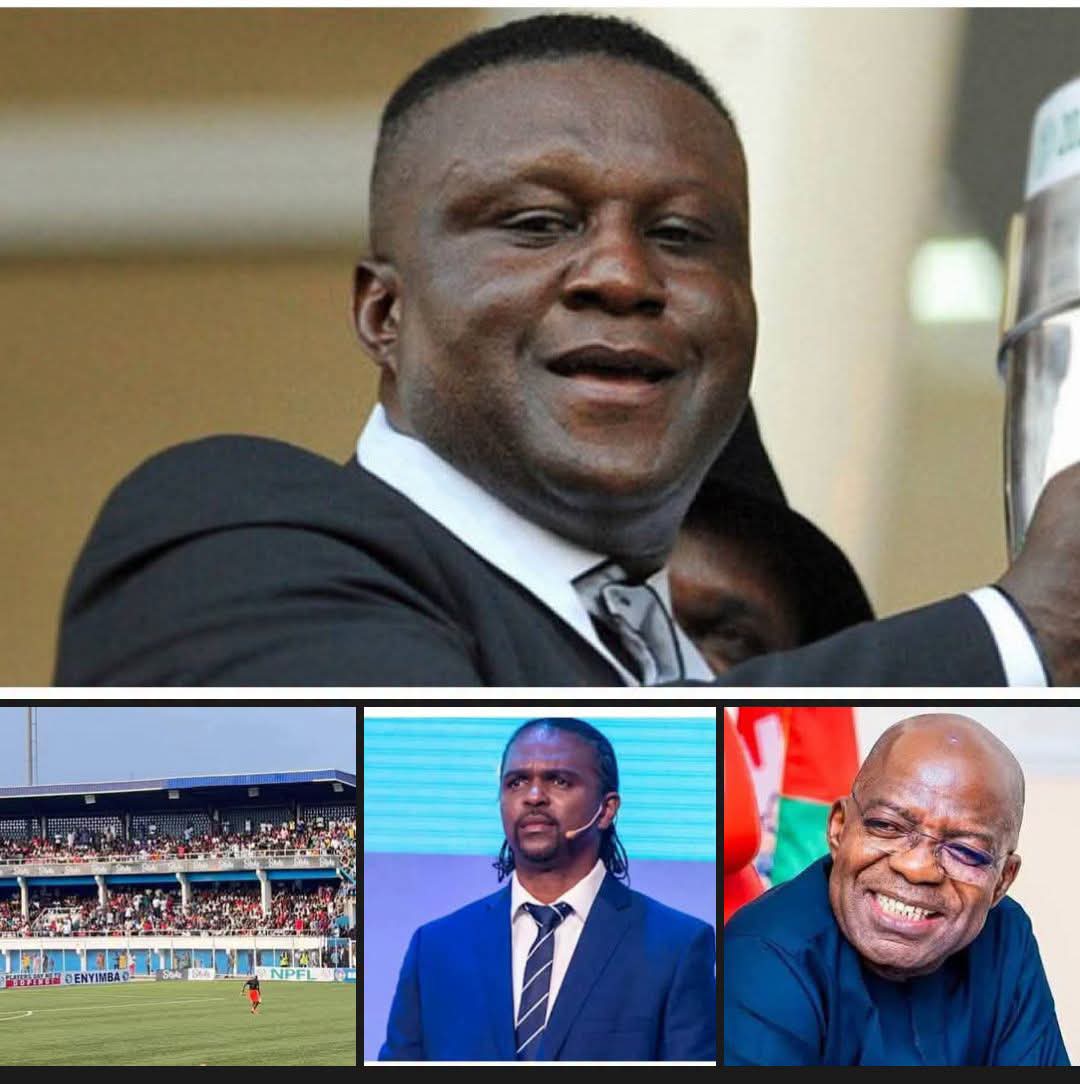
The History of Felix Anyansi-Agwu: The Man Who Built Enyimba into an African Giant
There was a time when the name Felix Anyansi-Agwu was almost inseparable from Enyimba Football Club of Aba.
For more than two decades, if you talked about Enyimba, you were talking about Anyansi-Agwu. And if you talked about Nigerian club football, it was almost impossible to tell the story without mentioning the man who sat in the chairman’s office in Aba and watched the club grow from a relatively modest Nigerian side into a giant of African football.
His story is one of the most remarkable chapters in the history of Nigerian club football.
Felix Anyansi-Agwu was born around 1965 and came into football administration rather than making his name as a professional footballer.
His big opportunity came around the year 2000, when the then Governor of Abia State, Senator Orji Uzor Kalu, appointed him to lead Enyimba.
At the time, nobody could have known just how far the club would go.
Enyimba was a respected Nigerian club, but it was not yet the continental powerhouse that generations of football fans would come to know.
Anyansi-Agwu inherited a club that needed structure, ambition and investment. Under his leadership, Enyimba gradually began to change.
The club became more organised. The players became more competitive. The ambition became bigger.
And then came 2003.
The night Enyimba conquered Africa
In 2003, Enyimba reached the summit of African club football by winning the CAF Champions League.
For Nigeria, it was a historic moment.
The country had waited 39 years for another Nigerian club to win Africa’s biggest club competition. Enyimba finally ended that long wait.
But perhaps the most remarkable part was that it was not a one-off achievement.
In 2004, Enyimba did it again.
They successfully defended the CAF Champions League title and became the first Nigerian club to win the competition twice.
Suddenly, Aba was no longer just known for its markets, industries and commercial energy.
It had a football club that Africa had begun to fear and respect.
The Peoples’ Elephants had arrived.
More than trophies
The success did not stop with the Champions League.
Under Anyansi-Agwu, Enyimba became the dominant force in Nigerian domestic football.
League titles followed. Federation Cups followed. Continental competitions became almost an annual expectation.
By the time Anyansi-Agwu eventually left the club, Enyimba had won nine Nigerian league titles, alongside its two CAF Champions League trophies and two CAF Super Cups.
For a club from Aba, this was extraordinary.
Enyimba had gone from being one of many Nigerian clubs to becoming arguably the country’s most decorated club side.
And Anyansi-Agwu was sitting at the centre of it all.
The man behind the chairman’s desk
Football administration is not always glamorous.
Players receive the applause. Coaches receive the headlines. Goalscorers become heroes.
But behind every successful club is somebody dealing with contracts, finances, recruitment, coaches, players, government officials, football authorities and the countless problems that supporters never see.
That was the world Anyansi-Agwu occupied for more than two decades.
He became known for his determination, calmness and ability to keep the club focused.
In an interview, he summed up his philosophy simply:
“Focus is everything. Focus and purposefulness, regardless of the results.”
That mentality became part of the identity of the club.
His influence went beyond Enyimba
Anyansi-Agwu’s reputation eventually took him beyond Aba.
He became deeply involved in Nigerian football administration and served in several positions within the Nigeria Football Federation.
He chaired and served on various NFF committees, including the Technical Committee, Beach Soccer Committee, Players’ Status Committee and Marketing Committee.
He also led Nigeria’s delegation to the 2013 Africa Cup of Nations, where the Super Eagles went on to win the tournament.
His administrative achievements were recognised by CAF, which named him Africa’s Best Football Administrator in 2004 and 2005.
Back home in Abia, he was also honoured with traditional titles, including Oke Oji of Abia and Enyi Abia.
By then, his name had become firmly attached to the golden era of Enyimba.
Twenty-four years later, everything changed
Then, in 2023, after roughly 24 years at the helm, the Anyansi-Agwu era came to an end.
Interestingly, he did not leave after Enyimba had suffered relegation or after the club had gone through a disastrous season.
Quite the opposite.
He left shortly after Enyimba had won the 2022/23 NPFL title, their ninth Nigerian league championship.
The newly elected Abia State Governor, Alex Otti, dissolved the existing Enyimba board and appointed Nigerian football legend Nwankwo Kanu as the club’s new chairman.
And just like that, one of the longest chapters in Enyimba’s history came to an end.
The man who had spent more than two decades building the club was gone.
A new era had begun.
Kanu arrives
Kanu Nwankwo hardly needed an introduction.
He was one of the greatest footballers Nigeria had ever produced.
He had won the UEFA Champions League with Ajax, Olympic gold with Nigeria and was twice named African Footballer of the Year.
So when Kanu was appointed chairman of Enyimba, there was enormous excitement.
A football legend was coming home to lead one of Nigeria’s biggest clubs.
But football administration is different from playing football.
The skills that make someone a great footballer do not automatically translate into running a football institution.
And the years that followed became increasingly difficult for Enyimba.
From champions to a club fighting for survival
This is where the Enyimba story becomes painful for supporters who remember the club of the Anyansi-Agwu era.
The club that once conquered Africa began struggling for consistency.
There were coaching changes, administrative disagreements, disputes over the club’s leadership structure and reported problems involving player welfare, bonuses and finances.
Questions increasingly emerged about who was actually in charge of different aspects of the club.
At one point, reports described a situation involving two coaches and two sporting directors, reflecting the growing administrative confusion around the club.
And then came the 2025/26 season.
The mighty Enyimba found itself fighting to avoid relegation.
Think about that for a moment.
This was the same club that had conquered Africa twice.
The same club that had dominated Nigerian football for years.
The same club that had once made Enyimba International Stadium one of the most intimidating grounds in Nigerian football.
Now, they were fighting simply to remain in the NPFL.
On the final day of the season, Enyimba needed a victory against El-Kanemi Warriors.
They won 3–0.
That victory saved the club from relegation and moved them to 11th position with 49 points.
For Enyimba supporters, it was relief—but it was also a painful reminder of how dramatically the club’s fortunes had changed.
What happened to the Enyimba we knew?
Anyansi-Agwu left immediately after Enyimba won the league.
Within three seasons, the club had gone from Nigerian champions to fighting relegation.
That contrast naturally raises questions about what changed inside the club.
Was it the administrative structure?
Was it recruitment?
Was it finances?
Was it coaching?
Was there too much government involvement?
Was there a failure to maintain the institutional system that had been built over two decades?
Or was it a combination of several factors?
Those are questions that deserve serious examination.
Whatever anyone thinks of Felix Anyansi-Agwu personally, his record at Enyimba is difficult to erase.
He took charge around the beginning of the millennium.
He remained there for roughly 24 years.
During that period, Enyimba won nine Nigerian league titles, two CAF Champions League trophies and two CAF Super Cups, among numerous other honours.
He helped turn a Nigerian club into an African powerhouse.
He gave Aba a club that millions of Nigerians became proud to associate with the city.
And he helped create an era in which Enyimba was not simply participating in African football—it was competing at the very top.
Today, when supporters look at Enyimba’s struggles, many inevitably remember the old days.
The packed stadium.
The intimidating atmosphere in Aba.
The continental nights.
The Champions League trophies.
The confidence that Enyimba could face almost any African club and compete.
Those memories belong to a particular era.
And at the heart of that era was a man who spent more than two decades sitting quietly behind the scenes, building, managing and defending the interests of the club.
Felix Anyansi-Agwu may no longer be the chairman of Enyimba, but his fingerprints remain all over the greatest chapter in the club’s history.
The question now is whether Enyimba can find another long-term vision capable of restoring the club to the level it once reached under the man who helped turn the Peoples’ Elephants into an African giant.