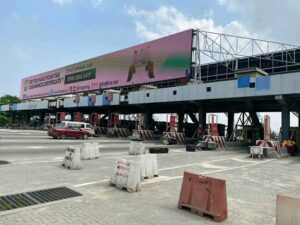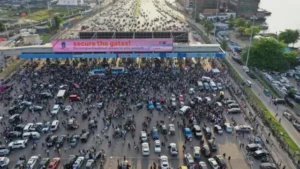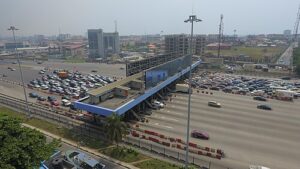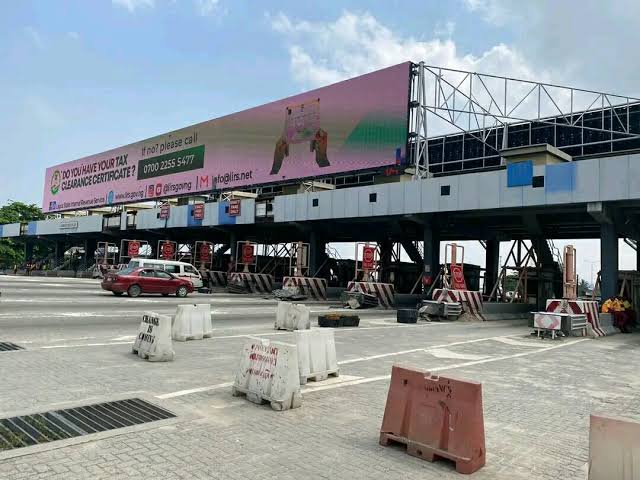
History About October 20, 2020, How Nigerian security forces and the Nigerian Army opened fire on peaceful, unarmed #EndSARS protesters gathered at the Lekki Toll Gate in Lagos, Nigeria
In a report on 21 October, Amnesty International stated that at least 12 protesters were killed in what the organization described as “extrajudicial executions”.
A former marketer with Etisalat Telecommunications Company (now 9Mobile) was reported to be one of the casualties. Denying this, Lagos State Governor, Babajide Sanwo-Olu, claimed that no one was killed at Lekki and later posted on Twitter that one person died at the hospital as a result of blunt force trauma to the head, and that the connection to the protest was under investigation.
The Nigerian military denied responsibility for the shooting, tweeting that media reports were “fake news”.
According to witnesses, the military did not allow ambulances to provide aid and removed corpses from the scene of the shooting.
In testimony during April and May 2021 before the Lagos State Judicial Panel, a witness stated that by her reckoning based in part on video evidence at least 10 people died in the shooting. According to Premium Times reporting, they could count five bodies from the videos with many additional injuries.
On 23 July 2023, Lagos State Governor Babajide Sanwo-Olu approved of the mass burial of 103 protesters who lost their lives during the EndSars incident.
On the day of the shooting, on 20 October 2020, the government imposed a city-wide round-the-clock curfew in Lagos which was to start at 4 p.m. which had only been announced earlier that day around 1 p.m. via social media.
Protesters defied the curfew although it was later extended till 9 p.m. by the Lagos State Governor, staging several demonstrations, and gunfire could be heard throughout the city.
Several fires burned throughout Lagos after the shooting. A few hours after the massacre, the Lagos State Governor visited the injured victims in hospitals in Lagos. In a statement on Twitter, he attributed the massacre to “forces beyond our direct control.”
The following days after the Lekki massacre witnessed a lot of violence by hoodlums not associated with the #EndSars protest.[47] The looting of shops, burning and destruction of properties of private individuals and government in some parts of Lagos began late in the night of the massacre and spilled into the following morning until military personnel were deployed to the streets of Lagos to restore calm and order.
- The Date & Time: The shooting began around 6:50 p.m. on the evening of October 20, 2020, following a 24-hour curfew declared by Lagos State Governor Babajide Sanwo-Olu.
The Protest: Thousands of Nigerian youths had gathered peacefully for weeks to demand an end to police brutality, corruption, and the disbandment of the Special Anti-Robbery Squad (SARS), waving the Nigerian flag and singing the national anthem.
The Conditions: Before the military moved in, lights and surveillance cameras at the toll gate were turned off.
Casualties and Findings: An independent judicial panel set up by the Lagos State Government and human rights organizations like Amnesty International reported that at least 10 to 12 peaceful protesters were killed, with many others sustaining gunshot wounds and injuries.
Aftermath & Memorials: The Lagos State Judicial Panel of Inquiry classified the event as a massacre. Annual memorial gatherings at the Lekki Toll Gate continue to face heavy police presence and occasional deployment of tear gas by security forces.
The Nigerian Army has been known to open fire and kill unarmed civilians in previous incidents, most notably was the and 2018 attack on Shiite Muslims who were protesting against the jailing of a cleric in which 45 Nigerians were killedog Three sons of Sheikh El-Zakzaky were killed alongside about 30 other followers of the Sheikh on July 25, 2014. Since the country’s return to civilian rule in 1999, soldiers have killed unarmed civilians in several incidents including: Odi, Zaki Biam, Baga, Zaria, and Abonema.
The incident at the Lekki tollgate on October 20, 2020, however runs contrary to the above examples as the testimonies documented in the leaked report of the Judicial panel of inquiry and the subsequent white paper released by the Lagos State government’s committee to review the aforementioned report do not support the narrative that a massacre indeed occurred at the Lekki tollgate.
Although the panel members relied almost exclusively on testimony provided by an alleged eyewitness to arrive at a conclusion, the expert testimonies by the pathologist and two forensic teams engaged by the panel and the Lagos State government did not however support the summary of the 309-page report.
End SARS is a decentralised social movement and series of mass protests against police brutality in Nigeria. The slogan calls for the disbanding of the Special Anti-Robbery Squad (SARS).
In 2016, a human rights activist, Segun Awosanya popularly known as Segalink started EndSARS campaign on social media prompting police authority to announce reform of the police unit but nothing was achieved at the time. In 2018, Nigerian rapper Michael Ugochukwu Stephens, known by his stage name Ruggedman, joined the campaign to end police brutality releasing a single titled, “Is Police Your Friend?
The protests became more popular in 2017 on Twitter using the hashtag #EndSARS to demand the Nigerian government disband and reform the police unit.
Within a few days of renewed protests, some claimed victory when, on Sunday, 11 October 2020, the Nigerian Police Force announced it would be dissolvi However, many noted similar promises had been made in recent years, and that the government planned to reassign and review SARS officers to medical centers rather than remove them entirely. The Lekki toll gate shooting promptly ended the protest movement.