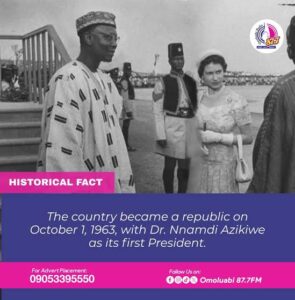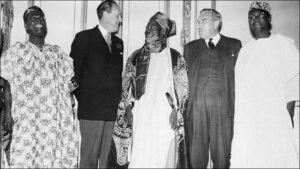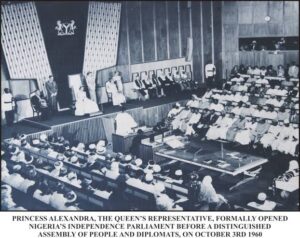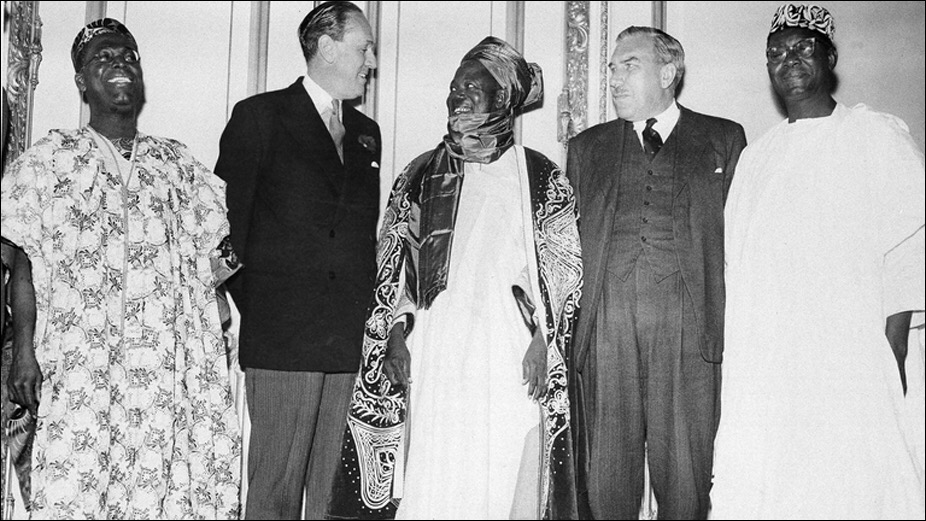
Nigeria officially became a federal republic on October 1, 1963 (rather than October 10), marking the birth of the First Nigerian Republic and the end of its status as a constitutional monarchy under Queen Elizabeth II.
- Date of Adoption: October 1, 1963 (three years after gaining independence on October 1, 1960).
Head of State: Dr. Nnamdi Azikiwe transitioned from Governor-General to become Nigeria’s first ceremonial President First Nigerian Republic
Head of Government: Sir Abubakar Tafawa Balewa remained the Prime Minister. [1]
System of Government: Federal parliamentary system with a bicameral legislature (Senate and House of Representatives).
Major Changes:
- Replaced the British monarch with a Nigerian president.
- Ended final judicial appeals to the Privy Council in the United Kingdom, establishing the Supreme Court of Nigeria as the highest court.
- Created the Mid-Western Region out of the Western Region.
End of the Republic: The First Republic ended on January 15, 1966, following a military coup d’état
The federal government of Nigeria is composed of three distinct arms: the executive, the legislative, and the judicial, whose powers are vested and bestowed upon by the Constitution of the Federal Republic of Nigeria. One of the primary functions of the constitution is that it provides for separation and balance of powers among the three branches and aims to prevent the repetition of past mistakes made by the government. Other functions of the constitution include a division of power between the federal government and the states, and protection of various individual liberties of the nation’s citizens
Nigerian politics take place within a framework of a federal and presidential republic and a representative democracy, in which the president holds executive power.
Legislative power is held by the federal government and the two chambers of the legislature: the House of Representatives and the Senate. The legislative arm of Nigeria is responsible for and possesses powers to legislate laws. Together, the two chambers form the law-making body in Nigeria, called the National Assembly, which serves as a check on the executive arm of government. The National Assembly of Nigeria (NASS) is the democratically elected body that represents the interests of the Federal Republic of Nigeria and its people, makes laws for Nigeria, and holds the Government of Nigeria to account. The National Assembly (NASS) is the nation’s highest legislature, whose power to make laws is summarized in chapter one, section four of the 1999 Nigerian Constitution. Sections 47–49 of the 1999 Constitution state, among other things, that “There shall be a National Assembly (NASS) for the federation which shall consist of two chambers: the Senate and the House of Representatives.”The Economist Intelligence Unit rated Nigeria a “hybrid regime” in 2019.
The federal government, state, and local governments of Nigeria aim to work cooperatively to govern the nation and its people. Nigeria became a member of the British Commonwealth upon its independence from British colonial rule on 1 October 1960.[
Legislation as a source of Nigerian law
The two fundamental sources of Nigerian law through legislation are:
(1) Acts of British parliament, popularly referred to as statutes of general application during the period before independence.
(2) Local legislation (comprising enactments of the Nigerian legislatures from colonial period to date). There were other sources which, though subsumed in Nigerian legislations, were distinctly imported into the Nigerian legal systems. They are called the criminal and penal codes of Nigeria.
Nigerian statutes as sources of Nigerian law
Nigerian legislation may be classified as follows: The colonial era until 1960, post-independence legislation 1960–1966, the military era 1966–1999.
Post-independence legislation 1960–1965
The grant of independence to Nigeria was a milestone in the political history of the country. This period witnessed the consolidation of political gains made during the colonial era. Politicians genuinely focused their lapses on the polity. It achieved for herself a republican status by shaking off the last vestiges of colonial authority. However, despite the violent violation of its provisions, the constitution remained the subsequent administrations (military or otherwise).
Military regime, 1966–1999
The Armed Forces of Nigeria assumed the rulership of Nigeria from 1966–1979 and 1983–1999. The breakdown of law and order which occurred in the period under review would not be attributed to any defect in the Nigerian legal system. Corrupt practices both in the body politics and all aspects of Nigerian life eroded efficiency and progress. There were eight coups generally; five were successful and three were unsuccessful.