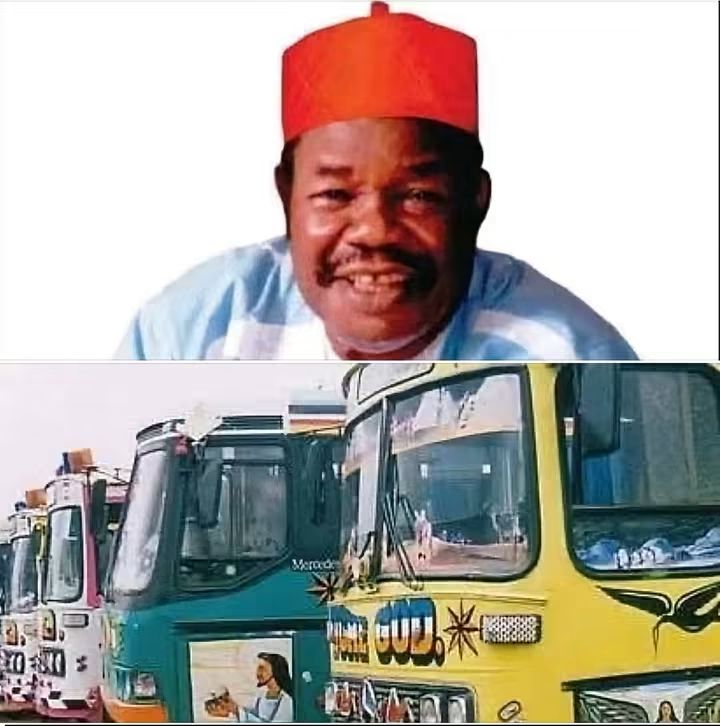
THE HISTORY AND BIOGRAPHY OF CHIEF AUGUSTINE EJIKEME ILODIBE: FOUNDER EKENE DILI CHUKWU TRANSPORT.
THE FORGOTTEN ARCHITECTS OF NIGERIA’S ECONOMY: CHIEF AUGUSTINE EJIKEME ILODIBE: THE MAN WHO BUILT ONE OF NIGERIA’S GREATEST TRANSPORT EMPIRES
Imagine building a business from one lorry in 1955 and eventually creating a transport empire that reportedly employed about 4,000 people and operated approximately 1,000 vehicles.
That was the extraordinary story of Chief Augustine Ejikeme Ilodibe, the founder of Ekene Dili Chukwu Transport.
Today, many Nigerians know the name Ekene Dili Chukwu, but surprisingly, many younger Nigerians know very little about the man whose entrepreneurial vision helped transform road transportation in Nigeria.
Here is his story.
1. HE STARTED WITH VERY LITTLE
Augustine Ejikeme Ilodibe was born on 18 December 1932 in Nnewi, present-day Anambra State.
He experienced hardship early in life, losing his father when he was still a child.
He eventually found his way into business through apprenticeship and trading in automobile spare parts.
In 1955, he purchased his first lorry from SCOA Motors in Onitsha and entered the transportation business.
By November of that same year, he had ordered a second lorry.
That was the beginning of what would become one of Nigeria’s most recognisable indigenous transport businesses.
2. HE BUILT A TRANSPORTATION EMPIRE
Ilodibe understood something important: transportation was not just about moving passengers. It was about connecting markets, businesses, communities and opportunities.
His company expanded rapidly.
By 1974, the business reportedly had approximately 50 buses.
By the 1980s and 1990s, Ekene Dili Chukwu had become one of the dominant interstate transport operators in Nigeria.
A historical study of Nigerian entrepreneurs published in the 1990s documented the company at approximately:
1,000 vehicles.
4,000 employees.
These figures illustrate the extraordinary scale of indigenous private enterprise in Nigeria at the time.
3. HE HELPED MODERNISE INTERSTATE TRANSPORTATION
One of Ilodibe’s greatest contributions was introducing and popularising more comfortable luxury buses for long-distance Nigerian journeys.
Between 1974 and 1979, his company introduced Mercedes-Benz luxury bus models, including the 0362 and 0364.
This helped change public expectations about interstate transportation.
Rather than accepting uncomfortable journeys as normal, Nigerians increasingly experienced organised long-distance travel with improved comfort.
His business helped connect cities such as Lagos, Onitsha, Enugu, Aba, Owerri, Port Harcourt and other commercial centres.
Transportation became an important instrument for expanding commerce and national integration.
4. HE DID NOT JUST BUILD A TRANSPORT COMPANY. HE BUILT AN INDUSTRIAL GROUP.
This is perhaps the most impressive part of his story.
Ilodibe understood that a successful business should not depend entirely on one source of revenue.
He diversified into several related industries.
His business interests included:
A. Ekene Dili Chukwu Transport
Passenger transportation, road haulage and logistics.
B. Ekene Dili Chukwu Motors
Vehicle distribution, Mercedes-Benz trucks, buses, spare parts and automobile services.
C. Ekene Dili Chukwu Steel Structures
Vehicle body manufacturing, firefighting equipment, refuse disposal containers and bullion vans.
The company was established following a 1975 study of Nigeria’s vehicle body-building requirements.
It worked with German technical experts.
D. United Modern Insurance Brokers
Established in 1978 to provide insurance advisory, pension and claims consultancy services.
E. Austin Farms and Allied Industries
Incorporated in 1986, this agricultural enterprise occupied approximately 500 hectares at Anaku in present-day Anambra State.
Its activities included poultry, piggery, fish farming, livestock feeds, hatchery operations and agricultural production.
Think about that for a moment.
A man who started with one lorry eventually developed interests in transportation, automobile distribution, manufacturing, insurance and agriculture.
5. HE CREATED EMPLOYMENT AND INSPIRED A GENERATION OF ENTREPRENEURS
One of the most important contributions of Ilodibe was the employment his business generated.
The historical estimate of approximately 4,000 employees demonstrates the scale of the company’s contribution to Nigerian livelihoods.
But his impact went beyond direct employment.
His success demonstrated that Nigerians could build sophisticated transportation businesses capable of competing on a national scale.
His achievements also inspired other entrepreneurs in the Southeast to establish major transport companies.
The development of companies such as Young Shall Grow Motors, Ekeson Brothers and other indigenous transport operators formed part of a wider expansion of Nigerian private transportation entrepreneurship.
Ilodibe helped demonstrate that transportation could become a large-scale, professionally managed industry rather than simply an individual commercial activity.
6. HE INTRODUCED PROFESSIONAL MANAGEMENT INTO INDIGENOUS TRANSPORT BUSINESS
Another remarkable achievement was his approach to business administration.
Rather than operating solely as a family-owned transport venture dependent on the founder’s personal supervision, he developed an organisational structure.
His company had:
A board of directors.
A general management structure.
Accounting and auditing departments.
Legal and purchasing departments.
Maintenance operations.
Public relations.
Staff training and retraining.
This was an important development in an industry where many transport businesses operated with limited administrative structures.
He understood that building a business was one thing; building an institution that could operate beyond its founder was another.
7. THE SAD LESSON OF HIS BUSINESS EMPIRE
Ilodibe died on 1 July 2007.
Unfortunately, his business empire subsequently experienced serious difficulties.
Family disagreements, financial problems and corporate governance challenges contributed to the decline of its transport operations.
The company that once represented the possibilities of indigenous Nigerian entrepreneurship became a reminder of the dangers of failing to establish effective succession and institutional governance.
His story raises an important question for Nigerian entrepreneurs:
Are we building businesses that can survive us, or businesses that will collapse when we are gone?
—
THE BIGGER LESSON FOR NIGERIA
Chief Augustine Ejikeme Ilodibe’s story teaches us several important lessons.
1. Great businesses do not necessarily begin with enormous capital. They begin with vision, discipline and the ability to identify opportunities.
2. Transportation is economic infrastructure. Every bus connecting two cities creates opportunities for traders, workers, students and businesses.
3. Diversification creates economic resilience. Ilodibe did not limit himself to transportation; he ventured into manufacturing, agriculture, insurance and automobile distribution.
4. Indigenous entrepreneurship is essential to economic independence. A country cannot achieve sustainable economic development by depending entirely on foreign businesses.
5. Succession planning is as important as business expansion. An empire without strong institutions can decline after its founder’s departure.
My question is this:
If Nigeria had deliberately supported and developed more entrepreneurs like Augustine Ilodibe, how different would our transportation and manufacturing industries look today?
We spend so much time discussing politicians who failed Nigeria that we sometimes forget the men and women who tried to build Nigeria through enterprise.
We must document their achievements, study their decisions and teach the next generation from their experiences.
Chief Augustine Ejikeme Ilodibe was more than a transporter. He was an institution builder, an industrial entrepreneur and one of the pioneers of indigenous Nigerian capitalism.
May his legacy continue to inspire a new generation of Nigerian entrepreneurs.
THE HISTORY AND BIOGRAPHY OF CHIEF AUGUSTINE EJIKEME ILODIBE: FOUNDER EKENE DILI CHUKWU TRANSPORT.
