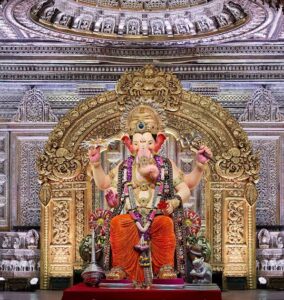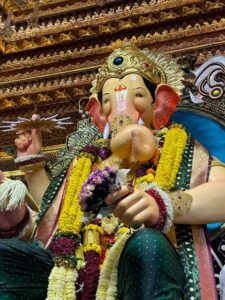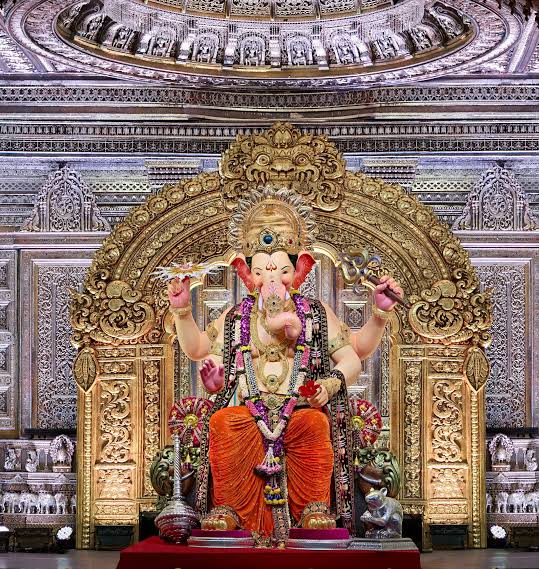
Lalbaugcha Raja is one of Mumbai’s most famous public Ganesh idols and the centerpiece of the annual Ganesh Chaturthi celebrations organized by the Lalbaugcha Raja Sarvajanik Ganeshotsav Mandal in Lalbaug, Mumbai. The tradition dates back to 1934 and has its roots in the local fishing and trading community’s search for a permanent marketplace.
Unlike a traditional temple that remains permanently installed, Lalbaugcha Raja is an annual Ganeshotsav idol that is installed during the festival and later taken in procession for immersion on Anant Chaturdashi. Over the decades, the celebration has become a major part of Mumbai’s cultural and religious calendar, attracting very large numbers of devotees for darshan.
The mandal is celebrating its 93rd year in 2026, with the festival running from September 14 through September 25. The official mandal announced that the ceremonial installation took place at 5:00 AM on September 14, while the Mukh Darshan and Charan Sparsh queues opened after 6:00 AM.
What Does Lalbaugcha Raja Mean?
“Lalbaugcha Raja” translates approximately to “King of Lalbaug” in Marathi.
The name refers to the Lord Ganesha idol installed by the Lalbaugcha Raja Sarvajanik Ganeshotsav Mandal in the Lalbaug area of Mumbai. The idol is also popularly associated with the name Navsacha Ganpati, referring to the tradition of devotees making a navas, or religious vow, to Lord Ganesha.
The belief that prayers and vows made at Lalbaugcha Raja are fulfilled is part of the devotional tradition surrounding the idol. This is a matter of religious belief rather than something that can be independently verified.
When Was Lalbaugcha Raja Established?
Lalbaugcha Raja dates back to 1934.
Historical accounts state that a market near Peru Chawl was closed in 1932, affecting local fishermen, vendors and traders who depended on the area for their livelihoods. The community wanted a permanent marketplace and, according to the traditional account, made a vow to Lord Ganesha.
After land was made available for a new market, the fishermen and traders installed a Ganesh idol on September 12, 1934, as an expression of gratitude. The event became the foundation of the Lalbaugcha Raja tradition.
There is some variation in historical sources about whether the mandal itself was formally established in 1928 or 1934. The current historical account most commonly associated with the idol identifies 1934 as the year of the first Lalbaugcha Raja installation.
Why Was Lalbaugcha Raja Created?
The origins of Lalbaugcha Raja are closely connected with the livelihood of local fishermen, traders and vendors.
When the earlier market at Peru Chawl was shut down, people who depended on the market were left without a permanent place to conduct their businesses. According to the traditional account, they prayed for a new marketplace and made a navas, or vow, to Lord Ganesha.
The community eventually obtained land for a permanent market. The first Lalbaugcha Raja idol was then installed in September 1934.
This history explains why the idol became associated with wishes, vows, livelihood and gratitude. The story has been passed down as an important part of the identity of the Lalbaug Ganeshotsav.
Who Made the Lalbaugcha Raja Idol?
The distinctive appearance of Lalbaugcha Raja is closely associated with the Kambli family of sculptors.
According to historical accounts, Madhusudan Donduji Kambli began making the idol in 1935, and the responsibility was subsequently passed through generations of the Kambli family. Their work helped establish the recognizable seated, royal appearance associated with Lalbaugcha Raja today.
The idol’s familiar facial features, posture, crown and overall presentation have become closely identified with the Lalbaugcha Raja tradition.
Where Is Lalbaugcha Raja Located?
Lalbaugcha Raja is installed in the Lalbaug area of Mumbai, Maharashtra, India.
The mandal’s annual pandal is associated with Putlabai Chawl in Lalbaug. During Ganesh Chaturthi, the area becomes one of the major destinations for devotees visiting Mumbai’s famous Ganpati celebrations.
Because of the enormous crowds, visitors should check current entry routes, traffic restrictions and queue arrangements before travelling to the pandal.
When Is Lalbaugcha Raja 2026?
The Lalbaugcha Raja 2026 Ganeshotsav began on Monday, September 14, 2026, and will continue until Friday, September 25, 2026, which is Anant Chaturdashi.
The official mandal identifies 2026 as its 93rd year. The ceremonial installation took place at 5:00 AM on September 14, followed by the opening of the darshan arrangements.
The first look of the 2026 idol was unveiled on September 11, three days before Ganesh Chaturthi. Reports described this year’s pandal as having a temple-inspired design with prominent decorative elements.
Lalbaugcha Raja 2026 Darshan Timings
According to the official mandal, the 2026 ceremonial installation took place at 5:00 AM on September 14.
The queues for Mukh Darshan and Charan Sparsh Darshan opened after 6:00 AM. Online darshan also became available from 6:00 AM on September 14 and is scheduled to continue until the immersion procession on September 25.
General darshan arrangements can change because of crowd management and festival-day conditions. Visitors should therefore check the official mandal updates before travelling.
What Is Mukh Darshan at Lalbaugcha Raja?
Mukh Darshan means devotees can view the face of Lalbaugcha Raja.
It is one of the main darshan options provided during the festival. The arrangement allows devotees to see the idol without joining the separate queue associated with approaching the feet.
The official mandal’s 2026 announcement confirms that Mukh Darshan and Charan Sparsh queues opened after 6:00 AM on September 14.
What Is Charan Sparsh Darshan?
Charan Sparsh Darshan refers to the darshan arrangement in which devotees can approach the feet of the idol.
This route is closely associated with the tradition of devotees making vows, or navas, to Lord Ganesha. Because of the large number of people who want to use this route, waiting times can be considerably longer than ordinary viewing.
Visitors should follow the instructions provided by the mandal and local authorities because crowd-management arrangements can change during the festival.
Is Lalbaugcha Raja Darshan Free?
Regular darshan at Lalbaugcha Raja is generally free.
The 2026 reporting on the festival states that the mandal does not charge devotees an official fee for standard Mukh Darshan or Charan Sparsh Darshan.
Visitors should be cautious about unofficial individuals or websites claiming to sell ordinary darshan access. The safest approach is to rely on announcements from the Lalbaugcha Raja Sarvajanik Ganeshotsav Mandal.
Can You Watch Lalbaugcha Raja Online?
Yes.
The official mandal provides online darshan during the Ganeshotsav period. For 2026, online darshan began at 6:00 AM on September 14 and is scheduled to continue until the immersion procession on September 25.
The mandal states that online darshan can be accessed through its official website, YouTube channel, Facebook page, Instagram account, X account and mobile applications.
Official Lalbaugcha Raja website: Lalbaugcha Raja Sarvajanik Ganeshotsav Mandal
What Is the Significance of Lalbaugcha Raja?
The significance of Lalbaugcha Raja comes from a combination of religious devotion, community history and Mumbai’s Ganeshotsav tradition.
For devotees, the idol represents Lord Ganesha and is associated with the fulfillment of vows. For Mumbai, the celebration is also part of a long-standing public festival tradition in which neighborhoods come together around religious ceremonies, decorations, music and community activities.
The origin story is particularly connected with working people who wanted a permanent place to earn a livelihood. That history remains central to the identity of the mandal.
Why Is Lalbaugcha Raja So Famous?
Lalbaugcha Raja became famous because of its long history, distinctive idol design, religious significance and the large number of devotees who visit every year.
The idol’s association with Navsacha Ganpati has also contributed to its reputation. Devotees from Mumbai and other parts of India visit to make or fulfill vows and seek blessings.
The annual first-look ceremony has itself become a major event, while the immersion procession on Anant Chaturdashi attracts significant public attention.
Lalbaugcha Raja and the Kambli Family
The Kambli family’s connection with Lalbaugcha Raja is one of the longest-running artistic traditions associated with the idol.
The family began creating the idol in 1935, shortly after the first installation. Over subsequent generations, the Kambli family maintained the distinctive design that has become recognizable as Lalbaugcha Raja.
This artistic continuity is one reason the idol has retained a consistent visual identity even as the annual decorations and pandal designs have changed.
Lalbaugcha Raja and Ganesh Chaturthi
Ganesh Chaturthi is the festival during which Lalbaugcha Raja is installed and worshipped.
The festival generally involves the installation of Ganesh idols, daily prayers and cultural activities, followed by immersion on Anant Chaturdashi.
In 2026, Ganesh Chaturthi began on September 14, with Anant Chaturdashi and the Lalbaugcha Raja immersion scheduled for September 25.
Lalbaugcha Raja 2026 Donations
Lalbaugcha Raja has also attracted significant donations during the 2026 festival.
During the first three days of Ganeshotsav, reports stated that the mandal received donations totaling approximately ₹3.18 crore. The amount included ₹1.90 crore in cash, along with gold and silver contributions.
The reported donations included approximately 647.47 grams of gold and 12,389 grams of silver during that initial three-day period.
The money and valuables are handled through established procedures, with reports stating that the funds are deposited and used for social initiatives associated with the mandal.
The mandal’s activities extend beyond the annual Ganeshotsav.
Its official website reports that the Lalbaugcha Raja Dialysis Centre has operated for more than 15 years and received a certificate of appreciation from the National Accreditation Board for Hospitals & Healthcare Providers in 2026.
The mandal has also provided assistance during difficult circumstances. In August 2026, it announced financial support for the Bhuleshwar Cha Raja Ganeshotsav Mandal following an accident involving devotees. The announced assistance included ₹11 lakh to the mandal and ₹5 lakh each to the families of two people who died.
These activities form part of the broader community-service role associated with the organization.
Did Lalbaugcha Raja Continue During COVID-19?
The traditional Lalbaugcha Raja festival was not held in its usual form in 2020 because of the COVID-19 pandemic.
The mandal instead focused on COVID-19 awareness and related community activities.
This was an unusual interruption in a tradition that had continued for decades and demonstrated how the festival adapted to extraordinary public-health circumstances.
When Is Lalbaugcha Raja Visarjan 2026?
The Lalbaugcha Raja visarjan is scheduled for Friday, September 25, 2026, on Anant Chaturdashi.
Visarjan is the traditional immersion ceremony that marks the conclusion of Ganesh Chaturthi. The idol is taken through Mumbai in a large procession before being immersed.
The immersion procession is one of the most significant public events associated with the Lalbaugcha Raja festival.
Lalbaugcha Raja 2026 Latest News
As of September 23, 2026, Lalbaugcha Raja is in the middle of its 93rd annual Ganeshotsav.
The idol was unveiled on September 11, while public darshan began on September 14. Devotees can continue visiting through September 25, when the immersion procession is scheduled to take place.
The first three days of the festival also generated reports of ₹3.18 crore in donations, including cash, gold and silver.
The 2026 celebration has therefore combined the traditional darshan and immersion rituals with the mandal’s continuing community activities.
Frequently Asked Questions About Lalbaugcha Raja
What is Lalbaugcha Raja?
Lalbaugcha Raja is a famous Lord Ganesha idol installed annually by the Lalbaugcha Raja Sarvajanik Ganeshotsav Mandal in Mumbai during Ganesh Chaturthi.
When was Lalbaugcha Raja started?
The first Lalbaugcha Raja idol was installed on September 12, 1934, following a vow associated with the creation of a permanent marketplace for local fishermen and traders.
Where is Lalbaugcha Raja located?
Lalbaugcha Raja is located in the Lalbaug area of Mumbai, Maharashtra, at the annual pandal associated with the mandal.
The idol is called Navsacha Ganpati because of the tradition of making a navas, or vow, to Lord Ganesha. The name is associated with the belief that devotees’ wishes are fulfilled.
Who makes Lalbaugcha Raja?
The Kambli family of sculptors has been associated with making the Lalbaugcha Raja idol since 1935.
When is Lalbaugcha Raja 2026?
The 2026 festival runs from September 14 to September 25, 2026.
When is Lalbaugcha Raja visarjan 2026?
The 2026 immersion procession is scheduled for Friday, September 25, which is Anant Chaturdashi.
Is Lalbaugcha Raja darshan free?
Yes. Regular Mukh Darshan and Charan Sparsh Darshan are free according to current 2026 festival information.
What time does Lalbaugcha Raja darshan start?
For the 2026 festival, the official mandal stated that the Mukh Darshan and Charan Sparsh queues would open after 6:00 AM on September 14. General arrangements can change during the festival, so visitors should check official updates.
Can I watch Lalbaugcha Raja online?
Yes. The official mandal provides online darshan through its website, social-media accounts, YouTube channel and mobile applications.
How long does Lalbaugcha Raja darshan last?
The 2026 darshan period runs from September 14 until the immersion procession on September 25.
What is special about Lalbaugcha Raja?
Its importance comes from its 1934 origins, connection with local fishermen and traders, distinctive Kambli family idol design, religious significance and large annual following.