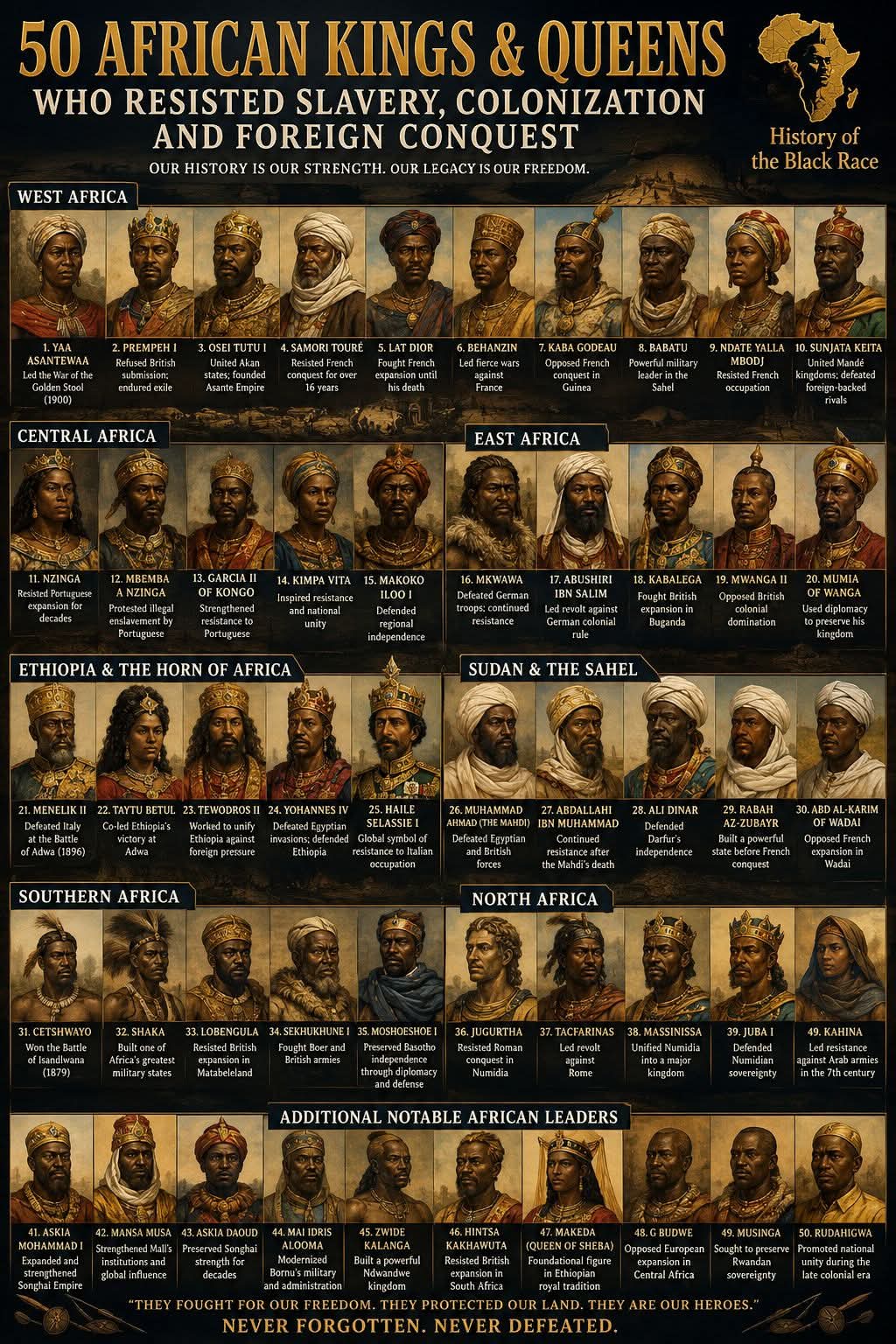
The History of the 50 African Kings and Queens Who Resisted Slavery, Colonialism and Foreign Conquest
Africa’s history is much broader than the story of European colonisation. Long before the colonial borders of today were drawn, African kingdoms, empires and societies developed powerful political institutions, armies, diplomatic systems and trading networks.
When foreign powers attempted to expand into African territories, impose political control, seize land, dominate trade or participate in the enslavement and forced removal of Africans, many African rulers resisted. Some fought on battlefields; others relied on diplomacy, strategic alliances, economic resistance or the protection of their people.
It is also important to be historically precise: not every person on this list opposed slavery, colonialism and foreign conquest simultaneously. Some resisted European colonial occupation; some fought earlier foreign invasions; some opposed the enslavement of their own populations; and others defended political sovereignty against foreign commercial or military interference.
For example, Queen Nzinga fought Portuguese expansion and attempted to halt Portuguese slave raiding in her territories, while King Afonso I of Kongo protested the illegal enslavement of Kongolese subjects. At the same time, some African states themselves participated in systems of slavery, demonstrating how complicated the history of slavery in Africa was.
Here are 50 notable African rulers and royal leaders associated with resistance to foreign conquest, colonial domination, slave raiding or the destruction of African sovereignty.
1. Queen Amanirenas — Kingdom of Kush
Present-day Sudan | c. 40–10 BCE
Amanirenas, the famous Kandake of Kush, led one of the ancient world’s notable African resistance campaigns against Rome. After Roman forces occupied Egypt, Kush came under threat. Amanirenas mobilised a large army and attacked Roman positions in Lower Nubia.
Her forces captured Roman-controlled settlements before Rome launched a counteroffensive. The eventual negotiations resulted in Roman withdrawal from significant areas and the cancellation of taxation imposed on Meroë. Her resistance remains one of the clearest examples of an African kingdom successfully confronting Roman imperial expansion.
2. Queen Dihya — Amazigh North Africa
Present-day Algeria/Tunisia region | 7th century
Known in Arabic sources as al-Kahina, Dihya became associated with Amazigh resistance to the Umayyad conquest of North Africa.
Although details surrounding her life are contested and later traditions contain legendary elements, historians generally recognise her as a major figure in the resistance to Arab expansion into the Maghreb.
3. Queen Nzinga Mbande — Ndongo and Matamba
Present-day Angola | c. 1583–1663
Nzinga is one of Africa’s most famous resistance leaders.
She confronted Portuguese expansion, slave raiding and attempts to subordinate Ndongo and Matamba. She combined diplomacy, military strategy and alliances, including an alliance with the Dutch against Portugal.
Nzinga also provided sanctuary to people escaping Portuguese-controlled areas. Her resistance against Portuguese expansion lasted for decades.
Her history, however, is complex: she also operated within the political and economic realities of the regional slave trade. Historical accounts therefore should not portray her simply as a modern-style abolitionist.
4. King Afonso I of Kongo
Present-day Angola/DRC/Congo | c. 1509–1542
Afonso I corresponded with the Portuguese monarchy and repeatedly complained about the kidnapping and illegal enslavement of Kongolese people.
He attempted to restrict the export of freeborn Kongolese and sought greater control over Portuguese activities in Kongo.
Historical evidence shows that Kongo itself participated in systems of slavery, making Afonso’s position primarily a defence of Kongolese sovereignty and protection of his subjects from uncontrolled Portuguese enslavement rather than a modern abolitionist campaign.
5. King Álvaro I of Kongo
Present-day Democratic Republic of Congo/Angola | 16th century
During the upheavals surrounding the Jaga invasions, large numbers of Kongolese were captured and sold.
Álvaro I attempted to recover Kongolese subjects who had been transported toward São Tomé and sought to restore people taken into slavery.
His actions demonstrate how Kongo’s monarchy sometimes attempted to protect its population from external slave trafficking.
6. King Moshoeshoe I — Basotho Kingdom
Present-day Lesotho | c. 1786–1870
Moshoeshoe I built the Basotho kingdom during a period of enormous political upheaval in southern Africa.
He used diplomacy, fortified mountain settlements and military organisation to protect his people from rival African forces, Boer expansion and later British territorial ambitions.
Rather than relying exclusively on warfare, Moshoeshoe became famous for combining military resistance with negotiation.
7. King Sekhukhune I — Bapedi Kingdom
Present-day South Africa | c. 1814–1882
Sekhukhune I resisted Boer expansion and later confronted British forces.
His kingdom became an important centre of resistance to attempts by external powers to impose political control over the Pedi people.
British forces eventually defeated and imprisoned him, but his resistance became an important episode in the history of southern African opposition to colonial expansion.
8. King Cetshwayo kaMpande — Zulu Kingdom
Present-day South Africa | c. 1826–1884
Cetshwayo was the Zulu king during the Anglo-Zulu War of 1879.
His forces famously defeated a British army at the Battle of Isandlwana, one of the most significant African military victories against a European imperial power during the colonial period.
Britain eventually defeated the Zulu kingdom and captured Cetshwayo, but his resistance remains central to the history of African opposition to colonial conquest.
9. King Dingane kaSenzangakhona — Zulu Kingdom
Present-day South Africa | c. 1795–1840
Dingane confronted the Voortrekkers during the expansion of Boer settlers into Zulu territory.
His forces destroyed a large Voortrekker contingent at the Battle of Ncome/Blood River in 1838, although later military developments turned against him.
His reign represents an early phase of Zulu resistance to European settler expansion.
10. King Dinuzulu kaCetshwayo — Zulu Kingdom
Present-day South Africa | c. 1868–1913
Dinuzulu succeeded during a period when Zulu political independence had already been seriously weakened.
He became involved in resistance and political struggles surrounding the preservation of Zulu authority against British domination.
The British eventually arrested and imprisoned him, further reducing the independence of the Zulu monarchy.
11. King Makhado — Venda Kingdom
Present-day South Africa | 19th century
Makhado resisted Boer attempts to extend control over Venda territory.
He used military resistance and knowledge of the northern Transvaal landscape to defend his political independence.
His campaigns formed part of the broader resistance to settler expansion in southern Africa.
12. King Lobengula — Ndebele Kingdom
Present-day Zimbabwe | c. 1845–1894
Lobengula was the last major king of the Ndebele kingdom.
He attempted to use diplomacy to protect his kingdom as British interests and the British South Africa Company expanded into the region.
When colonial pressure intensified, conflict followed. The First Matabele War eventually resulted in the destruction of much of Ndebele political independence.
13. King Khama III — Bechuanaland
Present-day Botswana | c. 1837–1923
Khama III used diplomacy rather than large-scale warfare to protect the territory of his people from external expansion.
He travelled to Britain with other African leaders and appealed directly to the British government for protection against Boer expansion and the ambitions of the British South Africa Company.
His strategy helped preserve a significant degree of territorial autonomy and contributed to the later emergence of Botswana.
14. King Lewanika — Lozi/Barotseland
Present-day Zambia | c. 1842–1916
Lewanika faced increasing pressure from European colonial interests.
Although he ultimately entered into a British protectorate arrangement, his diplomacy was aimed at preserving Lozi political authority and territorial interests in a rapidly changing environment.
His example demonstrates that resistance did not always mean fighting a European army; negotiation could also be used to protect sovereignty.
15. Chief Mkwawa — Hehe
Present-day Tanzania | c. 1855–1898
Mkwawa became one of the most important African military opponents of German colonial expansion in East Africa.
He led the Hehe resistance against German forces during the 1890s.
His forces inflicted serious losses on the German colonial army before Germany eventually pursued him for years.
16. Mangi Meli — Chagga Kingdom
Present-day Tanzania | died 1900
Mangi Meli was a ruler of the Chagga people who resisted German colonial domination around Mount Kilimanjaro.
He was eventually captured and executed by German colonial authorities.
His death became part of the history of Chagga resistance to German rule.
17. Omukama Kabalega — Bunyoro-Kitara
Present-day Uganda | c. 1853–1923
Kabalega was one of the strongest African opponents of British expansion in the Great Lakes region.
As ruler of Bunyoro, he fought British forces and their allies for years.
He was eventually captured and exiled, but his prolonged resistance prevented Britain from quickly consolidating control over Bunyoro. Mwanga II of Buganda was another major opponent of expanding British influence in the region.
18. Kabaka Mwanga II — Buganda
Present-day Uganda | 1868–1903
Mwanga II resisted increasing British influence over Buganda.
His reign coincided with intense competition between Christian missionaries, Muslims, traditional institutions and European colonial interests.
His resistance ultimately resulted in his overthrow and exile.
19. Emperor Tewodros II — Ethiopia
Ethiopia | c. 1818–1868
Tewodros II sought to reunify and strengthen Ethiopia at a time when European powers were expanding their influence in Africa.
He attempted to modernise Ethiopia’s military and central government and resisted foreign interference.
His confrontation with Britain culminated in the British expedition to Maqdala in 1868.
20. Emperor Yohannes IV — Ethiopia
Ethiopia | c. 1837–1889
Yohannes IV defended Ethiopia against several foreign threats, including Egyptian expansion and later Italian ambitions.
His reign helped preserve Ethiopian sovereignty during a period when European powers were dividing much of Africa.
He died fighting the Mahdists at the Battle of Metemma in 1889.
21. Emperor Menelik II — Ethiopia
Ethiopia | 1844–1913
Menelik II is perhaps the most internationally recognised African ruler associated with resistance to European colonialism.
When Italy attempted to impose its authority over Ethiopia, Menelik mobilised a massive Ethiopian army.
The resulting Battle of Adwa in 1896 ended in a major Ethiopian victory over Italy. Ethiopia subsequently remained independent while most of Africa fell under European colonial rule.
22. Empress Taytu Betul — Ethiopia
Ethiopia | c. 1851–1918
Taytu was Empress of Ethiopia and an important political figure during the crisis with Italy.
She supported resistance to Italian expansion and played an important role in mobilising Ethiopian forces before Adwa.
Sources describe Menelik and Taytu as working together to mobilise a diverse Ethiopian army.
23. Emperor Haile Selassie I — Ethiopia
Ethiopia | 1892–1975
Haile Selassie became a global symbol of Ethiopian sovereignty after Italy invaded Ethiopia in 1935.
He appealed internationally against the invasion and later returned to Ethiopia when Italian forces were defeated during the Second World War.
His 1936 speech before the League of Nations became an important episode in the international history of resistance to fascist aggression.
24. Sultan Ali Dinar — Darfur
Present-day Sudan | c. 1856–1916
Ali Dinar was the last independent Sultan of Darfur before the territory was incorporated into the Anglo-Egyptian Sudan.
He resisted British attempts to impose direct control over Darfur.
He was killed in 1916 during the Anglo-Egyptian campaign against his sultanate.
25. Sultan Muhammad Ahmad al-Mahdi — Sudan
Sudan | 1844–1885
Muhammad Ahmad declared himself the Mahdi and led a major revolt against Egyptian and British influence in Sudan.
His forces captured Khartoum in 1885, killing British General Charles Gordon.
The Mahdist state subsequently became one of the most significant examples of organised resistance to foreign rule in nineteenth-century Africa.
26. Emir Abd al-Qadir — Algeria
Algeria | 1808–1883
Abd al-Qadir organised Algerian resistance against French conquest in the nineteenth century.
He built a functioning political and military administration while leading sustained campaigns against French forces.
His resistance eventually ended in surrender, but he became a major symbol of Algerian opposition to French colonialism.
27. Sultan Ahmad al-Hiba — Morocco
Morocco | 1876–1919
Ahmad al-Hiba emerged as a major opponent of French colonial expansion in Morocco.
He was proclaimed Sultan in parts of southern Morocco and organised armed resistance against French occupation.
His forces fought the French during the early twentieth century.
28. Emir Abdelkrim al-Khattabi — Rif
Present-day Morocco | c. 1882–1963
Abdelkrim led the Rif resistance against Spanish and later French colonial forces.
Although commonly described as an emir rather than a conventional king, he headed the Rif Republic and created a highly organised resistance movement.
His forces defeated Spanish troops at the Battle of Annual in 1921.
29. Samori Touré — Wassoulou Empire
Present-day Guinea/Mali/Ivory Coast region | c. 1830–1900
Samori Touré created the Wassoulou Empire and developed a large military state.
When French expansion reached his territories, he resisted for years through conventional warfare, diplomacy, strategic relocation and military adaptation.
His forces were eventually defeated, and he was captured and exiled to Gabon, where he died in 1900.
30. Lat Dior — Cayor
Present-day Senegal | c. 1842–1886
Lat Dior was the Damel, or ruler, of Cayor.
He resisted French colonial expansion in Senegal for more than two decades.
He opposed French attempts to build a railway through his territory and fought French forces until his death in battle in 1886.
31. Ahmadou Sekou — Toucouleur Empire
West Africa | 19th century
Ahmadou Sekou succeeded Umar Tall as leader of the Toucouleur Empire.
He resisted French expansion and attempted to preserve the political structure inherited from his father.
His struggle formed part of the wider resistance to French conquest of the western Sudan.
32. Babemba Traoré — Kénédougou Empire
Present-day Mali/Burkina Faso region | died 1898
Babemba Traoré was the last ruler of the Kénédougou Empire.
When French forces attacked Sikasso in 1898, he resisted the siege rather than surrender.
After the city fell, Babemba reportedly chose death rather than accept French captivity.
33. Behanzin — Dahomey
Present-day Benin | c. 1844–1906
Behanzin was the last independent ruler of Dahomey before French conquest.
He refused to accept French demands for political control and led military resistance.
French forces eventually defeated Dahomey, and Behanzin was exiled.
The Metropolitan Museum records that failed negotiations and the French military campaign culminated in his exile and the occupation of Abomey.
34. Yaa Asantewaa — Asante
Present-day Ghana | c. 1840–1921
Yaa Asantewaa, Queen Mother of Ejisu, became the leading figure of the War of the Golden Stool in 1900.
She resisted British attempts to impose further control over Asante and became an important symbol of women’s leadership in African resistance.
The conflict demonstrated that Asante resistance continued even after earlier Anglo-Asante wars had weakened the kingdom.
35. Asantehene Prempeh I — Asante
Present-day Ghana | 1870–1931
Prempeh I attempted to preserve Asante independence as British power expanded.
British authorities eventually arrested and exiled him to the Seychelles.
His imprisonment became an important symbol of British attempts to dismantle Asante political sovereignty.
36. Nana Olomu — Itsekiri
Present-day Nigeria | 19th century
Nana Olomu was a major Itsekiri leader in the Niger Delta.
He resisted British commercial and political expansion and opposed British attempts to bypass his control of regional trade.
British authorities eventually defeated and exiled him.
Cambridge research places Nana alongside Jaja of Opobo and Ovonramwen among Niger Delta rulers removed because of their resistance to expanding British authority and commercial penetration.
37. King Jaja of Opobo
Present-day Nigeria | c. 1821–1891
Jaja rose from enslavement to become King of Opobo and one of the most powerful rulers in the Niger Delta.
He resisted British attempts to obtain unrestricted access to the palm-oil trade in his territory.
Britain eventually removed and exiled him.
His case illustrates how economic resistance and defence of commercial sovereignty could become part of the broader struggle against colonial expansion.
38. Oba Ovonramwen Nogbaisi — Benin Kingdom
Present-day Nigeria | died 1914
Ovonramwen was the Oba of Benin during the British invasion of 1897.
He resisted British attempts to bring Benin under colonial control.
After British forces captured and destroyed Benin City, Ovonramwen went into hiding before eventually surrendering. He was exiled to Calabar.
The British invasion resulted in the incorporation of Benin into colonial Nigeria and the looting of enormous quantities of royal artworks.
39. Awujale Ademuyiwa — Ijebu Kingdom
Present-day Nigeria | 19th century
The Ijebu kingdom resisted British expansion into Yorubaland.
The Awujale refused British demands concerning trade routes and political access, contributing to the conflict that became the British-Ijebu War of 1892.
Although British forces eventually defeated the Ijebu, their resistance became an important example of opposition to British conquest in Nigeria.
40. King Osei Tutu Agyeman Prempeh-related Asante royal leadership
Present-day Ghana | late 19th century
The Asante royal institution itself repeatedly resisted British attempts to subordinate the empire.
From the nineteenth-century Anglo-Asante conflicts through the 1900 War of the Golden Stool, Asante rulers and royal authorities defended political independence.
The Asante case demonstrates that resistance was not the work of a single individual but involved a wider political system of kings, chiefs, queen mothers and military commanders.
41. Queen Mother Nandi — Zulu
Present-day South Africa | c. 1760–1827
Nandi was the mother of Shaka Zulu and an important figure in the Zulu royal tradition.
While she did not lead an anti-European colonial war in the same manner as Cetshwayo, her place in the Zulu royal tradition belongs to the period of state formation and military transformation that preceded later Zulu resistance to European expansion.
Her story is therefore best understood in the context of the development of Zulu political power rather than as a direct anti-colonial campaign.
42. King Soshangane — Gaza Kingdom
Present-day Mozambique/Zimbabwe/South Africa | c. 1780s–1858
Soshangane founded the Gaza Kingdom during the turbulent period of nineteenth-century southern African state formation.
His kingdom confronted Portuguese interests in Mozambique and resisted attempts by external powers to dominate its territory.
Gaza remained an important independent African power until later Portuguese military campaigns.
43. King Gungunhana — Gaza Kingdom
Present-day Mozambique | c. 1850–1906
Gungunhana was the final ruler of the Gaza Empire.
Portuguese authorities sought to impose direct colonial control over his kingdom.
He resisted Portuguese expansion until his defeat in 1895. He was captured and exiled to the Azores, where he died.
44. King Sarhili kaHintsa — Xhosa
Present-day South Africa | c. 1815–1893
Sarhili was an important Xhosa king during a period of sustained conflict with British colonial expansion.
His reign was affected by the frontier wars between the Xhosa kingdoms and the British Cape Colony.
He resisted the loss of Xhosa territory and political independence.
45. King Sandile kaNgqika — Xhosa
Present-day South Africa | c. 1820–1878
Sandile was a major Xhosa leader during the frontier wars.
He opposed British attempts to extend colonial authority into Xhosa territory.
He died during the Ninth Frontier War in 1878.
46. Chief Maqoma — Xhosa
Present-day South Africa | c. 1798–1873
Although more accurately described as a Xhosa chief rather than king, Maqoma was one of the most persistent military leaders against British expansion.
He participated in several frontier wars and spent periods imprisoned on Robben Island.
His career illustrates the important role of non-monarchical African political leaders in anti-colonial resistance.
47. Chief Hintsa kaKhawuta — Xhosa
Present-day South Africa | c. 1780–1835
Hintsa was a paramount Xhosa king during the Sixth Cape Frontier War.
He became involved in negotiations with British authorities but was killed while attempting to escape British custody in 1835.
His death became a powerful symbol of the violent nature of colonial frontier expansion.
48. Mbuya Nehanda — Shona
Present-day Zimbabwe | 19th century
Nehanda Charwe Nyakasikana was a powerful spiritual and political figure associated with the First Chimurenga, the 1896–1897 uprising against British South Africa Company rule in what became Southern Rhodesia.
She was captured and executed by colonial authorities.
Although not a conventional queen, she occupied a highly influential traditional religious position and became an enduring symbol of Zimbabwean resistance.
49. Queen Mother Yaa Asantewaa’s Royal Resistance Network
Asante | 1900
Beyond Yaa Asantewaa herself, Asante’s royal women and chiefs played critical roles in organising resistance during the War of the Golden Stool.
The Golden Stool represented the spiritual and political sovereignty of the Asante nation. British attempts to assert authority over it helped trigger the 1900 uprising.
Yaa Asantewaa’s importance lies partly in the fact that she demonstrated that political and military leadership in African states was not exclusively male.
50. King Agaja — Dahomey
Present-day Benin | ruled 1718–1740
Agaja represents an earlier and more complicated phase of Dahomey’s history.
He strengthened Dahomey militarily and fought neighbouring powers, while his conquest of Ouidah brought the kingdom into direct contact with European slave traders.
His inclusion requires an important qualification: Agaja was not an anti-slavery ruler in the modern sense. Dahomey participated substantially in the Atlantic slave trade. His historical importance here is instead connected to the defence and expansion of African political sovereignty in the face of competing African and European commercial powers. The Metropolitan Museum documents Dahomey’s major involvement in the Atlantic slave trade following Agaja’s capture of Ouidah.
The Bigger Historical Picture
The 50 figures above reveal something important about African history: resistance to foreign domination was not a single event and did not follow one strategy.
African rulers responded to foreign pressure in very different ways.
1. Some chose armed resistance
Menelik II, Cetshwayo, Samori Touré, Mkwawa, Behanzin, Lat Dior, Ovonramwen and Kabalega are examples of leaders who used military force to defend territory or political authority.
African resistance was sometimes highly organised. Samori Touré, for example, developed a military state with an army estimated at tens of thousands of soldiers, while Menelik mobilised a very large multinational Ethiopian army before Adwa.
2. Others relied heavily on diplomacy
Moshoeshoe I, Khama III, Lewanika, Menelik II and several other rulers recognised that military resistance alone could not always protect their territories.
Diplomacy, treaties, alliances and appeals to foreign governments became weapons of their own.
3. Some fought against slave raiding
Queen Nzinga is an important example because Portuguese slave raiding was directly connected to the expansion of Portuguese power in Central Africa. She initially negotiated with Portugal to stop raids in her kingdom before later turning to armed resistance when the agreement broke down.
The rulers of Kongo also attempted at various points to protect Kongolese subjects from being illegally captured and exported.
4. African resistance was not always resistance to Europe
Amanirenas fought Roman imperial expansion nearly two thousand years before the European Scramble for Africa.
Dihya resisted the Umayyad conquest of North Africa.
Moshoeshoe, Dingane and other southern African rulers faced territorial expansion by neighbouring African states as well as European settlers.
This is why “foreign conquest” is broader than simply “European colonialism.”
5. African history also contains uncomfortable contradictions
It would be historically inaccurate to present every African ruler who fought European colonialism as an opponent of slavery.
Several African kingdoms participated in systems of slavery, warfare and captive-taking. Dahomey, Kongo, Oyo and other states were involved in complex regional systems of enslavement at different periods.
The Atlantic slave trade was not a simple story of “Europeans versus Africans.” European demand dramatically expanded and transformed existing systems, while African political authorities, merchants and communities participated in different ways. Other Africans resisted enslavement, were victims of it, or attempted to regulate and restrict it.
That complexity should not diminish the documented resistance to colonial conquest; rather, it makes the history more accurate.
The Legacy of African Resistance
From Amanirenas in ancient Kush to Menelik II at Adwa, Nzinga in Angola, Samori Touré in West Africa, Cetshwayo in Zululand, Ovonramwen in Benin, Yaa Asantewaa in Asante and Kabalega in Bunyoro, African rulers repeatedly demonstrated that European expansion was met with political, military and diplomatic resistance.
The colonial conquest of Africa was therefore not an uncontested process.
Historical research describes the first phase of European colonial conquest, particularly from roughly 1880 to 1910, as a period in which many African states and societies actively resisted European imperial expansion. Resistance took military, diplomatic, economic, religious and political forms.
Some resistance movements succeeded temporarily. Others were eventually defeated because European powers possessed major advantages in industrial weaponry, transportation, finance and military logistics. Yet defeat did not erase the fact that African societies made deliberate decisions to defend their sovereignty.
The story of Africa’s past is therefore not only a story of conquest.
It is also a story of kingdoms that fought, queens who commanded, kings who negotiated, communities that refused submission, and generations that continued the struggle for African sovereignty.
Sources and further reading
The historical details above draw particularly on research and educational material from the Metropolitan Museum of Art, Cambridge University Press, Open University, OER Project, Encyclopedia.com, South African History Online and the University of Northwestern’s Program of African Studies, alongside other historical references.
Editorial note: A few figures in popular lists are frequently described as “kings” or “queens” even though their historically accurate titles were queen mother, emir, chief, spiritual leader or paramount ruler. I have retained some of these figures where their role in organised resistance is historically significant, but identified the distinction rather than presenting the title inaccurately.