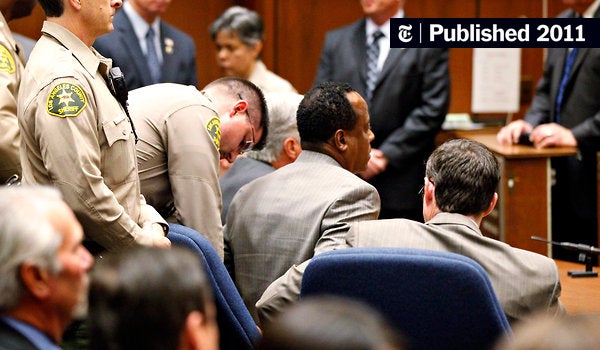
2011: A Los Angeles jury found Dr. Conrad Murray guilty of involuntary manslaughter in the 2009 death of pop star Michael Jackson.
Michael Jackson’s personal physician, Dr Conrad Murray, has been found guilty of the involuntary manslaughter of the star by a jury in Los Angeles.
A panel of seven men and five women took two days of deliberation to reach a verdict.
Michael Jackson died on 25 June 2009 from an overdose of the powerful anaesthetic propofol.
Murray, 58, could now receive a maximum prison term of four years and lose his licence to practise medicine.
There was a shriek in the courtroom as the verdict was read.
Outside the courthouse, the BBC’s Peter Bowes said that at the moment the verdict was read, the crowd along the street erupted with cheers and chanting.
Jackson’s family sat in the courtroom, weeping quietly.
LaToya Jackson told the Associated Press news agency the family was overjoyed at the verdict.
“Michael was looking over us,” she said.
During the trial, Dr Murray’s lawyers argued that Jackson self-administered a lethal dose of the drug while he was out of the room.
Dr Murray was remanded in custody without bail until he receives his sentence, set for 29 November.
Explaining his decision, the judge said Dr Murray was now a convicted felon and had considerable ties outside the state of California, meaning he could not guarantee that the doctor would remain in the state.
Dr Murray sat silently in court, shifting slightly in his seat as the verdict was read out.
Court officers began to handcuff the physician as the judge made his final announcements, before leading him away into custody.
‘Drug addict’
The jury – made up of one African American, six whites and five Hispanics – deliberated on Friday and through the morning on Monday.
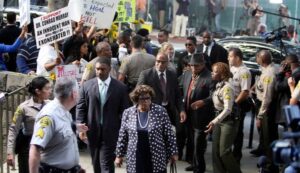
Outside the court, fans of Michael Jackson were cheering and chanting, “Guilty! Guilty!” in the run-up to the verdict being announced.
During the six-week trial, 49 witnesses and more than 300 pieces of evidence were presented to the court.
Michael Jackson, who had been out of the public eye for several years, died in 2009 as he was preparing for a series of comeback performances at the O2 arena in London.
In his closing argument last Thursday, the prosecution said Dr Murray had caused the star’s death through negligence, depriving Jackson’s children of their father and the world of a “genius”.
The defence argued that Jackson was a drug addict who caused his own death by giving himself an extra dose of propofol while the cardiologist was out of the room at the star’s rented mansion in Los Angeles.
However, lawyers for Dr Murray dropped a key argument midway through the trial – that the pop superstar had drunk the propofol. But they continued to argue that Jackson had somehow dosed himself otherwise.
Each side of the trial called their own expert witness on the anaesthetic drug.
There is no law against administering propofol, but the prosecution’s case rested on the argument that Dr Murray was grossly negligent by doing so outside a hospital setting and without the proper monitoring equipment.
In some of the more shocking moments of the trial, the jury heard a recording of Jackson, sounding incoherent and slurred, speaking about his upcoming concert series, as well as viewing a photo of a lifeless Jackson on a gurney.
Viewpoint: Justice for Conrad Murray
The last doctor of Michael Jackson’s life was convicted of manslaughter by a California jury because the law demanded it and the facts supported it.
Dr Conrad Murray was at Jackson’s home when the pop star died, sloppily administering medicine that should only have been administered in a hospital.
There are, I suspect, few jurors in the world who would have gone out of their way to search for a more complex narrative in order to spare the defendant a few years or months in jail.
Throughout the trial, Murray’s lawyers tried gingerly to blame Jackson himself for his own death, a tactic which reflected both the desperation of the defence case and the nature of California’s involuntary manslaughter statute.
Team Murray hoped that if jurors blamed the singer himself for an overdose, they might mete out a measure of sympathy for a doctor who, like so many other doctors who treat celebrities, thought he had his patient under control when he did not.
Bedside failings
California law, however, makes this a very difficult proposition. It is not enough to demonstrate, as Murray’s lawyers did, that the victim of the crime contributed to his own death.
Even if Jackson injected himself with the drug that ultimately killed him, prosecutors told jurors in closing arguments, Murray should have foreseen that this would occur because he knew that Jackson liked to “push” his own drugs.
Given this standard, what chance did Murray ever really have?
The prosecution’s theory resonated with the jury because it was founded on the language of the statute as announced during jury instructions. But when you stop and think about it, it is truly an extraordinary thing.
California is about to send a man to prison – for a while anyway – even though many reasonable people would agree that Jackson played a prominent role in his own death.
The law says that Murray should have known better, even if Jackson did not; that the doctor had a responsibility to his patient even if his patient were bent on pushing past medically acceptable standards.
You could say, as Murray’s lawyers implied, that the good doctor was in the wrong place at the wrong time. They acknowledged, as they had to, that their client’s professional performance during the fatal episode was not what any of us would want from our own bedside doctors.
But the defence lawyers tried to take the mens rea element, the criminal element, out of the case.
Murray may have been a quack, they argued, but he had absolutely no bad intent toward the richest patient he or any private doctor was ever likely to have.
Prison pending
Or you could say, as prosecutors did, that any good doctor would not have come anywhere near the circus that was Jackson’s relationship with prescription drugs.
Murray did not officially represent the King of Pop for long. But like everyone else in the world he surely knew that he was taking on a patient with a reputation for using drugs to try to tune out the demons which afflicted him.
The rest of world envisioned a tragic end for Jackson along these lines. After covering his 2005 molestation trial I certainly did. Why didn’t Murray?
The just-completed trial was a good one, in which the lawyers ably represented their causes and the trial judge, Los Angeles Superior Court Judge Michael Pastor, did a laudable job keeping control of a celebrity case.
On 29 November, during sentencing, I believe that Judge Pastor will show more mercy to Murray than did his jurors.
Murray faces anywhere from probation to four years, but it is clear from the fact that he is now in jail – the judge denied bail pending sentencing – that Judge Pastor is going to give him some prison time.
My bet is that the sentence will be towards the lower side.
California’s prisons are notoriously overcrowded. In fact, the state has been forced by the United States Supreme Court to reduce the prison population to more manageable levels.
Michael Jackson’s billion or so fans may argue that Conrad Murray deserves the hardest time possible. But the truth of the matter is that the eternal law of economics is on Murray’s side.
He made terrible errors in judgment, and he’s paying the price.
And none of that will ever bring back Michael Jackson or tell us what next might have happened had he lived through that day.
Michael Jackson was in good spirits. With less than three weeks to go before the start of a series of comeback concerts at London’s O2 arena even he, the ultimate perfectionist, had to admit things were looking good.
After viewing the video clips that would accompany such classic hits as Billie Jean and She’s Out of My Life, Jackson had led the company in their first dress rehearsal of Thriller.
When it was over he hugged the dancers and thanked the crew. Several of those who were present that night at the Los Angeles Staples Center said he was grinning from ear to ear.
It was a little after one o’clock in the morning by the time Jackson returned to the French chateau-style mansion he had been renting on the outskirts of Beverly Hills.
Waiting for him in his bedroom on the first floor was Conrad Murray. Tall and softly-spoken, Dr Murray had grown up on the Caribbean island of Grenada and like his father, who was also a doctor, moved to America in the hope of making a better life for himself.
He had been introduced to Michael Jackson three years previously by a patient who had worked for Jackson. On the night in question Dr Murray had served as the singer’s personal physician for barely two months.
Nevertheless, he was familiar with the routine.
Once Michael Jackson had emerged from the shower Dr Murray applied cream to his back to treat a pigmentation disorder known as vitiligo and the two men then settled into the more challenging aspect of their nightly ritual: getting Jackson to sleep.
Experience had taught Dr Murray that this could be a prolonged routine. On this occasion it was to last until well after sunrise.
Swarming with reporters
Fast forward to a little after noon on the same day and the calm of the eight-bedroom mansion was shattered by the sound of shouting from Jackson’s bedroom – followed a few minutes later by the sound of people racing up the stairs.
Paramedics responding to a call about a 50-year-old man suffering cardiac arrest found Michael Jackson sprawled across the floor in his pyjamas with a surgical cap on his head.
Oxygen tanks littered the doorway; a child-sized porcelain doll lay on the bed.
The heating was on – despite the fact that this was the middle of summer – and sweat was pouring down Dr Murray’s face as he attempted mouth-to-mouth resuscitation.
But one look at Jackson’s limp, lifeless body told the paramedics there was nothing they could do. His pupils were already dilated and his skin cold to the touch.
The faux French chateau, which Michael Jackson had been renting in LA – for a reported $100,000 (£62,000) a month – had seen some illustrious neighbours.
Barbra Streisand, Frank Sinatra, Mick Jagger and Cher had all called the same street home. But the fact that Jackson’s all-time idol Elvis Presley had once lived just around the corner may ultimately have been what persuaded him to move there.
Minutes after the news broke of Jackson’s death that same street – a stone’s throw from Sunset Boulevard – was swarming with reporters.
News helicopters hovered overhead, satellite trucks jammed the side streets.
It had been more than four years since I – or any other journalist present that day – had last seen Jackson. That was in the town of Santa Maria, in the heart of California wine country, following his acquittal on charges of child sex abuse in 2005.
Elusive sleep
Covering that trial every day for nearly four months I was struck by the effect the proceedings seemed to have on Jackson’s wellbeing.
We all remember the pictures of him shuffling into court in his pyjamas but there were times when he almost seemed to be withering away in front of our very eyes as details of his unorthodox lifestyle were dished up for the world to see.
Jackson considered the charges against him outrageous and the documentary which prompted them a “betrayal”.
Although the verdict went in his favour, there was little doubt in my mind that he left Santa Maria a broken man.
Unsurprisingly perhaps, friends say it was around the time of that court case that Jackson started finding it increasingly difficult to get to sleep.
He had suffered from a variety of ailments over the years but none compared to the torment he endured once the lights went out.
“I once said Michael would have paid a $1m for a good night’s sleep and though I was being somewhat facetious, in many ways it was true,” Jackson’s biographer J Randy Taraborrelli told the BBC.
“When stressed out he couldn’t sleep. Michael told me once that when he went to bed he couldn’t stop the creative process.
“He was always creating, imagining, wondering how things would work out and what he could do to make them better. ‘I can’t turn it off’ was how he put it to me. ‘I wish I could. But I can’t’.”
Meaning that the more he needed it, the more elusive sleep became.
Shadowy entourage
Hence the decision to go “doctor shopping” in a quest to find someone who would prescribe the one substance he knew could save him from sleeplessness.
Dr Conrad Murray told detectives he first became aware of propofol after he allowed another doctor to treat Jackson at his surgery in Las Vegas.
Jackson slept soundly and when he awoke the two men discussed the possibility of Murray accompanying Michael Jackson to London.
Dr Murray, who throughout that interview referred to Jackson as a “friend”, initially asked for $5m.
When the tour promoters, who were footing the bill on the Jackson’s behalf, baulked at that price he agreed to lower it to $150,000 a month.
Those who knew Michael Jackson well all seem to agree on one thing.
Gifted though he was as an entertainer – and, at times, as a businessman – as a judge of character his skills frequently left something to be desired.
Jackson’s sister La Toya referred to the “shadowy entourage” of handlers who frequently attached themselves to him like barnacles to a ship.
Over the years there was a virtual “revolving door” of assistants and advisors, many of whom seemed to bring a lot less to the table than they took from it.
“Michael put his trust in a lot of people over the years,” said Mr Taraborrelli.
“He always gave people the benefit of the doubt. He would wait until a person proved him wrong before that person would be ousted from his life. [In some cases] he waited too long.”
Neverland
The tragedy of this tale is that it could all have ended so very differently.
Once the concerts at London’s O2 arena had come to an end Michael Jackson was planning to take the show on a worldwide tour and use the proceeds to build a hospital for disadvantaged children, headed – you’ve guessed it – by Dr Conrad Murray.
He also intended to spend more time with his three children – Paris, Prince and Prince Michael II, known as Blanket – whom he was raising alone.
The mansion he once occupied may also have changed hands effortlessly had he survived.
Yet with Neverland long-since closed and Jackson’s grave off-limits to anyone other than family and friends, it has become – by default – a focal point for fans desperate for a link to their hero, no matter how macabre that link may be.
Which almost certainly was not what the owner – the head of the Ed Hardy fashion chain – had in mind when he bought the place.
He has made two attempts to sell it since Michael Jackson died but has yet to attract a buyer.
Murray trial: Jackson fans celebrate guilty verdict
On November 7 2012, A Los Angeles jury found Dr. Conrad Murray guilty of involuntary manslaughter on November 7, 2011, for the June 25, 2009, death of pop star Michael Jackson
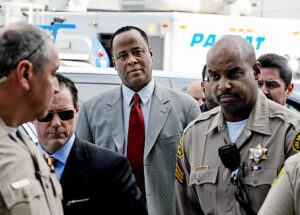
Michael Jackson’s doctor Conrad Murray arrives at the Los Angeles Airport Courthouse on February 8, 2010. Murray was charged with involuntary manslaughter ahead of a long-awaited court hearing where he is expected to deny causing the pop icon’s death. A statement from the Los Angeles County District Attorney’s Office — which had already confirmed criminal charges would be issued against Conrad Murray — set out the allegations against the 56-year-old physician. AFP PHOTO / GABRIEL BOUYS (Photo credit should read GABRIEL BOUYS/AFP/Getty Images) Original Filename: Was2857098.jpg