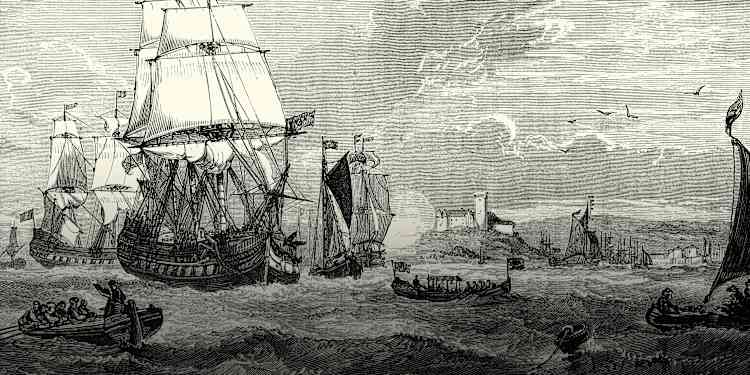
The History of East India Company And How They Became the World’s Most Powerful Monopoly.
One of the biggest, most dominant corporations in history operated long before the emergence of tech giants like Apple or Google or Amazon. The English East India Company was incorporated by royal charter on December 31, 1600 and went on to act as a part-trade organization, part-nation-state and reap vast profits from overseas trade with India, China, Persia and Indonesia for more than two centuries. Its business flooded England with affordable tea, cotton textiles and spices, and richly rewarded its London investors with returns as high as 30 percent.
But just when the East India Company’s grip on trade weakened in the late 18th century, it found a new calling as an empire-builder. At one point, this mega corporation commanded a private army of 260,000 soldiers, twice the size of the standing British army. That kind of manpower was more than enough to scare off the remaining competition, conquer territory and coerce Indian rulers into one-sided contracts that granted the Company lucrative taxation powers.
East India Company Founded Under Queen Elizabeth I

On the very last day of 1600, Queen Elizabeth I granted a charter to a group of London merchants for exclusive overseas trading rights with the East Indies, a massive swath of the globe extending from Africa’s Cape of Good Hope eastward to Cape Horn in South America. The new English East India Company was a monopoly in the sense that no other British subjects could legally trade in that territory, but it faced stiff competition from the Spanish and Portuguese, who already had trading outposts in India, and also the Dutch East Indies Company, founded in 1602.
Many of the hallmarks of the modern corporation were first popularized by the East India Company. For example, the Company was the largest and longest-lasting joint stock company of its day, which means that it raised and pooled capital by selling shares to the public. It was governed by a president, but also a “board of control” or “board of officers.” Unlike today’s relatively staid corporate board meetings, the East India Company’s meetings were raucous affairs attended by hundreds of stockholders.
“That incentive was to trade for their own private interest overseas,” says Erikson. “Employees of the East India Company would trade both within and outside of the rules that the Company granted. There were so many opportunities to fudge, cheat and smuggle. Think about jewelry, which is a very small and very expensive thing that you can hide on yourself easily.”
East Indies Trade Fueled Consumer Culture
“There’s this possibility of being ‘in the right style’ that hadn’t existed before,” says Erikson. “A lot of historians think this is the beginning of consumer culture in England. Once they brought over the cotton goods, it introduced this new volatility in what was popular.”
In India, Trade and Politics Blend

The trading post established by the British East India Company at Surat, India, c. 1680.
Universal History Archive/Getty Images
When the British and other European traders arrived in India, they had to curry favor with local rulers and kings, including the powerful Mughul Empire that extended across India. Even though the East India Company was technically a private venture, its royal charter and battle-ready employees gave it political weight. Indian rulers invited local Company bosses to court, extracted bribes from them, and recruited the Company’s muscle in regional warfare, sometimes against French or Dutch trading companies.
“The problem was, how would the East India Company rule these territories and by what principle?” says Tirthankar Roy, a professor of economic history at the London School of Economics and author of The East India Company: The World’s Most Powerful Corporation. “A company is not a state. A company ruling in the name of the Crown cannot happen without the Crown’s consent. Sovereignty became a big problem. In whose name will the company devise laws?”
This would be the equivalent of Exxon Mobil drilling for oil in coastal Mexico, taking over a major Mexican city using private armed guards, and then electing a corporate middle manager as the mayor, judge and executioner.
From Mercantile Company to Empire Building

Robert Clive receives from Shah Alam, the Mughal Emperor of India, a decree conferring upon the East India Company the administration of the revenues of Bengal, Behar and Orissa.
Hulton Archive/Getty Images
A major turning point in the East India Company’s transformation from a profitable trading company into a full-fledged empire came after the Battle of Plassey in 1757. The battle pitted 50,000 Indian soldiers under the Nawab of Bengal against just 3,000 Company men. The Nawab was angry with the Company for skirting taxes. But what the Nawab didn’t know was that the East India Company’s military leader in Bengal, Robert Clive, had struck a backroom deal with Indian bankers so that most of the Indian army refused to fight at Plassey.
“This completely changes the Company’s business model from one that had been focused on profitable trade to one that focused on tax collection,” says Erikson. “That’s when it became a really damaging institution, in my opinion.”
In 1784, the British Parliament passed Prime Minister William Pitt’s “India Act,” which formally included the British government in ruling over the East India Company’s land holdings in India.
The Opium Wars and the End of the East India Company

A British attack on the Canton River during the Opium War, 1840.
The exploits of the East India Company didn’t end in India. In one of its darkest chapters, the Company smuggled opium into China in exchange for the country’s most prized trade good: tea. China only traded tea for silver, but that was hard to come by in England, so the Company flouted China’s opium ban through a black market of Indian opium growers and smugglers. As tea flowed into London, the Company’s investors grew rich and millions of Chinese men wasted away in opium dens.
