The History of Umunede: An Ika-Igbo Kingdom in Western Igboland.
Umunede is an ancient Igbo kingdom of the Ika, one of the Igbo subgroups of western Igboland, west of the Niger. It sits in Ika North-East Local Government Area of Delta State. Umunede is counted among the major Ika-Igbo towns, alongside Agbor, Owa, Ute-Okpu, Ute-Ogbeje, Igbodo, Mbiri, Akumazi and Otolokpo, and it has long been an important farming and trading centre.
The town stands on fairly high ground along the Benin-Asaba road. Akumazi and Ekwuoma lie to the east, Agbor and Emuhu to the west, Mbiri to the north, Igbodo to the north-east, and Owa and Otolokpo to the south. That position has made it a natural meeting point for farmers, traders and travellers moving between Ika communities and the rest of western Igboland.
Where Umunede Fits in Igboland
Umunede is best understood as part of the Igbo story. The Ika are an Igbo subgroup, with their own dialect and local identity, but they share institutions, customs and speech with Igbo communities across the Niger. Research from the University of Delta notes that Ika culture has interacted with Edo neighbours as well as with other Igbo communities. Its institutions, however, are recognisably Igbo: traditional kingship, communal organisation, marriage customs and oral history.
Early colonial observers noticed something telling. Umunede’s traditions pointed toward Benin, yet its language and social organisation closely resembled those of the Igbo communities of Ogwashi and Ukwuani. Umunede’s culture therefore cannot be explained by a Benin origin story alone. It is a product of Igbo society at the western frontier, where communities lived alongside their Edo neighbours for centuries without losing their Igbo character.
Where the People Say They Came From
Umunede’s oral tradition traces the town to an ancestor named Ede. Frank Igwebuike, in a local historical account, dates the founding to around 1255 AD and names Ede and Iye as the founders. Their descendants are linked to the four main divisions of the town: Ileje, Obi, Oba and Ile.
The Obi of Umunede gave another version in an interview with The Guardian. In his telling, Ede was a prince of the Benin kingdom who left Benin and eventually settled in the area. The name Umunede then comes from Umu Ede, “the children of Ede.” This is a tradition rather than an independently established linguistic fact, and it is worth saying so plainly.
The Benin link is a genuine part of how Umunede remembers itself, and it deserves to be recorded. But the community grew up in an Igbo-speaking world and developed Igbo institutions, and colonial officials in the early twentieth century had already noticed the gap between what the people said about their origins and how they actually lived. Rather than choosing between the two, Umunede’s history can be read as one of migration, settlement and cultural formation on the western edge of Igboland, with Umunede firmly on the Igbo side of that frontier.
Four Divisions, Four Villages
The local account ties the descendants of the founders to four divisions: Ileje, Obi, Oba and Ile. It also records four major villages, or ogbe: Ogbe Obi, Idumuilege, Idumugba and Idumuile. Several keep the Idumu prefix, which suggests they began as smaller lineage groups or quarters that grew into full villages.
This is a familiar Igbo pattern. Authority is spread across lineages (umunna), quarters, villages, elders, title-holders and community assemblies, rather than resting on a single central ruler.
From Eze to Obi
Umunede’s kingship changed in the colonial era. According to IkaWorld, the town did not always use the Obi title. Its ruler was called the Eze, a title found across Igbo communities, until 1919, when Eze Onyeagwu received a royal Ada from Oba Eweka II of Benin. That event is linked to Umunede’s adoption of the Obi title.
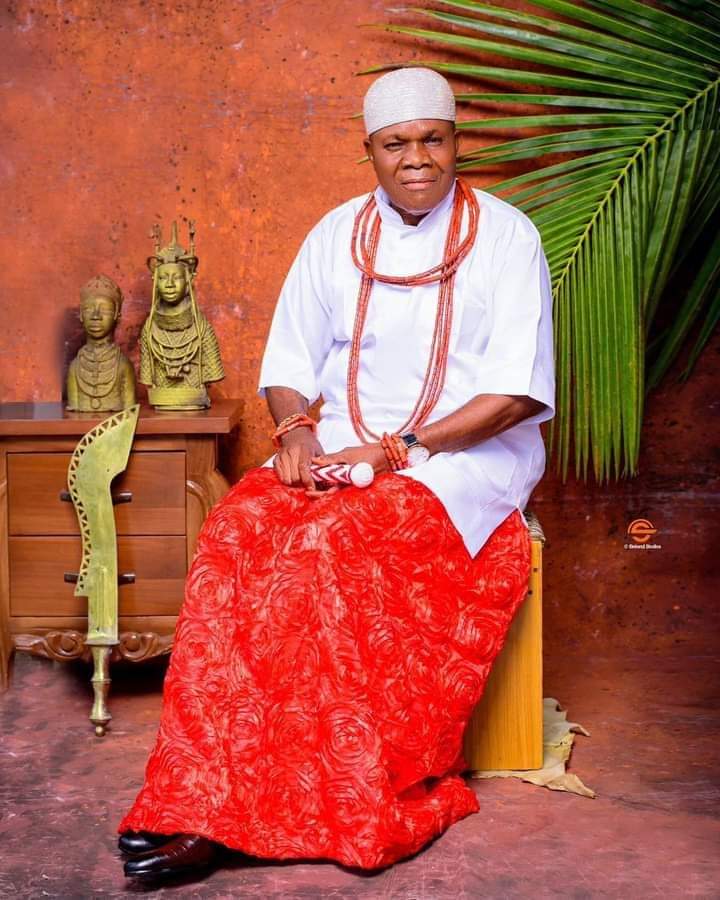
So the office of Obi is a comparatively recent development, and it shows how indigenous Igbo institutions and the Benin monarchy influenced each other. The throne today is held by Dr. Ezeagwu Ezenwali I, who succeeded his father in 1993 and is counted as the 17th Obi.
Traditional Religion and Priesthood
Umunede had its own religious institutions long before Christianity arrived. Information gathered by the Immigration and Refugee Board of Canada says the community historically had about 14 Okpukpus, which points to how central priests and lineage-based religious roles were. Detailed records of what these priests did, or how their positions were passed on, are thin, so claims about specific shrines should be treated with caution.
What we can say is that this belongs to the wider Igbo religious world, in which people kept their relationship with the land (ala), the ancestors and spiritual forces alive through priests, shrines, sacrifices, festivals and lineage authority.
Farming, Trade and Daily Life
Umunede sits in fertile country, and farming is still central to its economy. Yam, cassava and maize are among the main crops, along with other food crops and tree crops.
Its place on the Benin-Asaba corridor has made it a commercial hub as well. A recent historical study describes it as a place where farm produce is gathered and sent on to other parts of Nigeria. Everyday commerce and communication ran through the town crier, hawking, face-to-face selling and the markets.
Music mattered here too, and not just for entertainment. Recent academic work on Umunede describes music as part of social and economic life, used to pass on news and to promote trade.
Umunede in the Bigger Picture
Umunede shows how Igbo identity has many layers in the west. Its people are Igbo, and their Ika identity is the local expression of that. Their language, institutions and customs belong to the wider Igbo world, and contact with Benin and the Edo is a significant part of the town’s memory and political history.
That is why Umunede cannot be reduced to a “Benin colony,” and why its Benin traditions cannot simply be waved away either. It grew out of centuries of Igbo life at the western frontier, in contact with Edo neighbours, and out of that came the distinctive Ika-Igbo culture the kingdom has today.