The History And Everything You need to know about Ken Saro-Wiwa
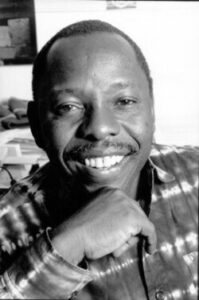
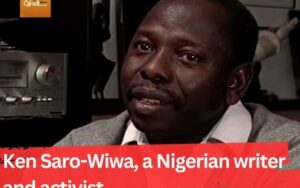
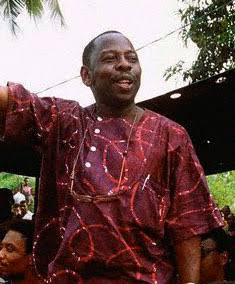
Ken Saro-Wiwa (born October 10, 1941, Bori, near Port Harcourt, Nigeria—died November 10, 1995, Port Harcourt) was a Nigerian writer and activist, who spoke out forcefully against the Nigerian military regime and the Anglo-Dutch petroleum company Royal Dutch/Shell for causing environmental damage to the land of the Ogoni people in his native Rivers state Ken Saro-Wiwa
Ken Saro-Wiwa was educated at Government College, Umuahia, and at the University of Ibadan. He briefly taught at the University of Lagos before joining federal forces in the civil war of the late 1960s. Afterward he worked as a government administrator until 1973, when he left to concentrate on his literary career.
Ken Saro-Wiwa first novels were Songs in a Time of War and Sozaboy (both 1985); the latter, written in pidgin English, satirized corruption in Nigerian society. He reached his largest audience with Basi and Company, a comedic television series that ran for some 150 episodes in the 1980s. He was also a journalist and wrote poetry and children’s stories.
From about 1991 he devoted himself full-time to the causes of the Ogoni, a minority ethnic group that numbered about 500,000 people. In mid-1992 he broadened the reach of the Movement for the Survival of the Ogoni People, an organization he led. In particular, he focused on Britain, where Shell had one of its headquarters.
He criticized the destructive impact of the oil industry—the main source of Nigeria’s national revenue—on the Niger delta region and demanded a greater compensatory share of oil profits for the Ogoni. As a result of mounting protest, Shell suspended operations in Ogoni lands in 1993.
“Lord take my soul, but the struggle continues.”
—Last words of Ken Saro-Wiwa
Saro-Wiwa was arrested in 1994 after the deaths of four Ogoni chiefs at a political rally. His trial by a special tribunal, appointed by the military, was denounced by foreign human rights groups.
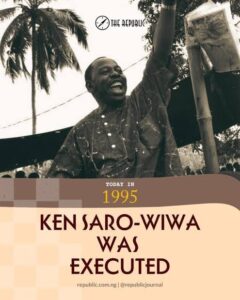
Saro-Wiwa was found guilty for alleged complicity in the murders and was sentenced to death. He and eight fellow activists, known as the Ogoni Nine, were executed by hanging, which aroused international condemnation and led to calls for economic sanctions against Nigeria, and the country was suspended from the Commonwealth a day after the executions. Shell later announced its commitment to a natural gas project worth nearly $4 billion, one of the largest foreign investments in Nigerian history.
In 2009 Shell paid $15.5 million in an out-of-court settlement intended to resolve a lawsuit brought against it in 1996 on behalf of members of Saro-Wiwa’s family and others. Shell, accused in the lawsuit of being complicit in human rights abuses in Nigeria and in the 1995 executions, denied any wrongdoing.
In 2025 Saro-Wiwa and the other Ogoni Nine activists were posthumously pardoned by Pres. Bola Tinubu, who also bestowed national honors upon them; Saro-Wiwa was awarded the Commander of the Order of the Niger.
News of the Ogoni Nine’s pardons and honors was celebrated, though some supporters felt a pardon implied guilt and pressed for them to be fully
Quotes from Saro-Wiwa:
“I’ve used my talents as a writer to enable the Ogoni People to confront their tormentors. I was not able to do it as a politician or a businessman. My writing did it… I think I have the moral victory.”
“The writer cannot be a mere storyteller; he cannot be a mere teacher; he cannot merely x-ray society’s weaknesses, its ills, its perils. He or she must be actively involved in shaping its present and its future.”
“I tell you this: I may be dead, but my ideas will not die.”
“The men who ordain and supervise this show of shame, this tragic charade, are frightened by the word, the power of ideas, and the power of the pen.”
“I have no doubt about the ultimate success of my cause, no matter the trials and tribulations that I and those who believe with me may encounter on our journey. Neither imprisonment nor death can stop our ultimate victory.”
“In this country [England], writers write to entertain; they raise questions of individual existence… But for a Nigerian writer in my position, you can’t go into that. Literature has to be combative.”
“Whether I live or die is immaterial. It is enough to know that there are people who commit time, money, and energy to fight this one evil among so many others predominating worldwide. If they do not succeed today, they will succeed tomorrow.”
“The stories that I tell must have a different sort of purpose from the artist in the Western world… and art, in that instance, becomes so meaningful both to the artist and to the consumers of that art because you do not just depend on them to read your books; you even have to live a life that they can emulate.”
The History And Everything You need to know about Ken Saro-Wiwa